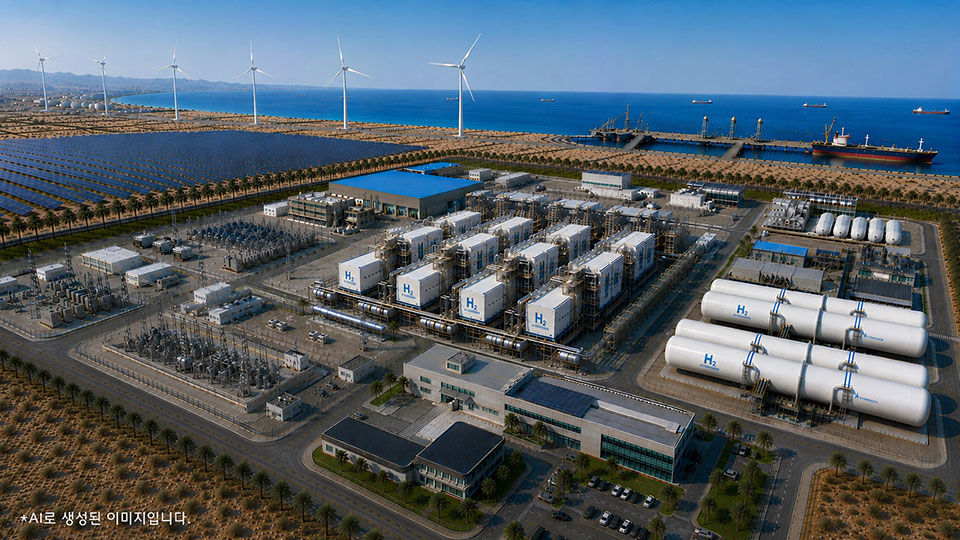
Hyundai Motor Group views hydrogen as a key energy source capable of supporting GHG emissions reduction not only in mobility,
but also across a wide range of industries, including power generation, logistics, and manufacturing.
Hydrogen can be produced, stored, transported, and utilized, helping address the limitations of renewable energy while supporting GHG emissions reduction in long-distance transportation and industrial sectors.
Hyundai Motor Group is contributing to the realization of a future energy society through GHG emissions reduction initiatives by building a hydrogen ecosystem that encompasses the entire value chain, from hydrogen production to utilization.
A hydrogen fuel cell is a technology that generates electricity through a chemical reaction between hydrogen and oxygen.
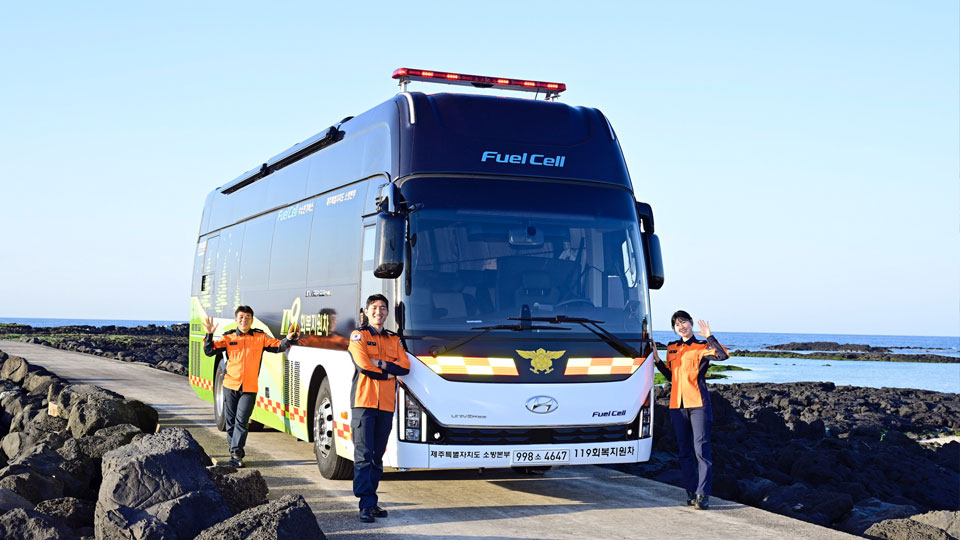
Hyundai Motor Group is applying hydrogen fuel cell systems not only to passenger and commercial vehicles, but also to a wide range of applications, including power generation facilities, logistics equipment, railways, and ships.
Through these efforts, the Group is expanding the use of hydrogen beyond mobility to the broader energy industry.
Hydrogen fuel cells are a technology that generates electricity through a chemical reaction between hydrogen and oxygen.
Hyundai Motor Group is applying hydrogen fuel cell systems not only to passenger and commercial vehicles,
but also across a wide range of applications, including power generation facilities, logistics equipment, railways, and ships.
Through these efforts, the Group is expanding the use of hydrogen beyond mobility to the broader energy industry.
Since introducing the mass-produced hydrogen fuel cell electric vehicle, the Tucson ix Fuel Cell, in 2013, Hyundai Motor Group has continuously advanced hydrogen technologies across both passenger and commercial vehicle segments.
Building on its expertise in hydrogen fuel cell technologies and system development, the Group offers a wide range of hydrogen mobility solutions—including passenger vehicles, buses, and trucks—and supports the expansion of the global hydrogen mobility market.
Hyundai Motor Group is continuing to invest in expanding hydrogen refueling infrastructure by building and operating hydrogen refueling stations, deploying hydrogen dispensers, and developing mobile hydrogen refueling stations.
The Group is also working with a range of companies and organizations to improve access to refueling infrastructure and create a more convenient environment for using hydrogen mobility.
Hydrogen fuel cell electric vehicles and battery electric vehicles are both electrified mobility solutions that produce no tailpipe emissions while driving.
Battery electric vehicles run on stored electricity, whereas hydrogen fuel cell electric vehicles generate electricity directly through hydrogen fuel cells.
In particular, hydrogen fuel cell electric vehicles offer advantages in commercial vehicle and long-distance transportation applications that require long driving ranges and fast refueling.
Alongside battery electric vehicles, they are considered key technologies driving the transition to future mobility.
For the hydrogen economy to become more widely established, an ecosystem is needed in which production, storage, transportation, refueling, and utilization are seamlessly connected.
Hyundai Motor Group is contributing to the expansion of the hydrogen ecosystem and GHG emissions reduction across society by advancing every stage of the value chain—from developing hydrogen production technologies and building refueling infrastructure to developing fuel cell systems and expanding hydrogen mobility.
Hyundai Motor Group is utilizing hydrogen not only in passenger and commercial vehicles, but also across a wide range of industries, including power generation, logistics, ports, airports, railways, and shipping.
In particular, the Group is developing distributed power generation facilities and industrial power supply solutions based on hydrogen fuel cell systems, while expanding their application to support GHG emissions reduction in large-scale logistics equipment and specialized transportation.
Through these efforts, Hyundai Motor Group is contributing to GHG emissions reduction across the energy and industrial sectors beyond mobility.