Hyundai E&C Expands Deployment of Unmanned Robots for On-Site Environmental and Safety Management
- Hyundai Engineering & Construction
- 2026.08.04 (KST)
- 분량6min
- 조회수 1,469Views
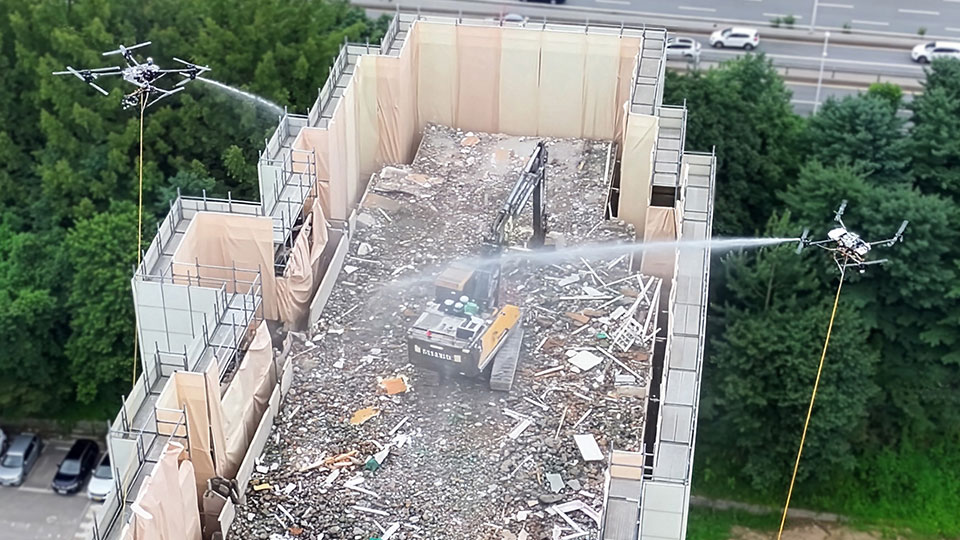
- Hyundai E&C Conducts On-Site Demonstration of Water-Spraying Drones at the Gwacheon Jugong Apartment Complexes 8·9 Reconstruction Project
- Hyundai E&C to Actively Adopt Smart Construction Technologies On-Site to Build a Safe and Sustainable Construction Environment
Hyundai E&C is moving to expand the use of unmanned robots for environmental and safety management at construction sites.
The company recently announced that it has completed a demonstration of fugitive dust suppression using water-spraying drones at the Gwacheon Jugong Apartment Complexes 8·9 Reconstruction Project site. Through the demonstration, Hyundai E&C comprehensively evaluated the performance, flight stability, and operational integration of the water-spraying drones in an actual demolition environment.
Demolition sites face a dual imperative: reducing fugitive dust while ensuring worker safety. Although dust suppression is an essential environmental management activity, it can expose workers to hazards such as slips, electric shock, and collisions with heavy equipment. Concerns about safety incidents are particularly acute in areas where worker and equipment access is limited, such as high-rise sections or structurally unstable zones, and dust management can reach its limits where sufficient water spraying is difficult to achieve.
Hyundai E&C conducted the demonstration by deploying water-spraying drones in areas of the construction site where fugitive dust was generated, concentrating 50 liters of water per minute within a radius of up to 12-15 meters under windless conditions. Because the drones were directly connected to power cables and water hoses, the system was not constrained by flight time or water supply volume. It also allowed spraying locations and coverage to be adjusted in real time to target frequently shifting dust-generating points, enabling flexible operation in step with construction progress.
Since remote control minimizes human access while permitting operation from any location, this method is expected to deliver significant improvements, not only in fugitive dust reduction but also in safety and operational efficiency, over conventional approaches that rely on water trucks or stationary dust suppression equipment.
A Hyundai E&C official stated, "Through this demonstration, we have confirmed the feasibility of applying water-spraying drones at demolition sites, and we plan to deploy them across a range of sites and demolition processes going forward." The official added, “Hyundai E&C is actively introducing a range of smart construction technologies, such as wearable robots, material-handling robots, and cleaning robots, at construction sites while carrying out active demonstrations in parallel. Building on these efforts, we will lead the way in creating a safer and more sustainable construction environment.”
Meanwhile, the HMG Construction Technology Research Institute, a consolidated R&D organization launched by Hyundai E&C and Hyundai Engineering, is dedicated to innovating construction sites through research and development in AI, robotics, automation, and digital technologies, with "Smart Construction Utilizing AI and Robotics to Enhance Safety and Quality and Prevent Human Error" as one of its four major research pillars. Accordingly, the institute is strengthening worker safety and site operational efficiency through a range of smart construction technologies, including ground-controlled tower cranes, the Spot quadruped robot, and unmanned drone stations. As the organization consolidating the R&D capabilities of Hyundai Motor Group's construction division, the HMG Construction Technology Research Institute plans to concentrate on its role as a construction and infrastructure technology hub that realizes the vision of becoming a “Smart Mobility Solution Provider.”