Hyundai E&C and Hyundai Steel Secure Technology for High-Performance Composite Beam Technology with Enhanced Structural Safety and Quality
- Hyundai Engineering & Construction
- 2026-11-18 (KST)
- 분량8min
- 조회수 1,110Views
AI summarized the main points
AI-generated summary. Please refer to the full article for precise details.
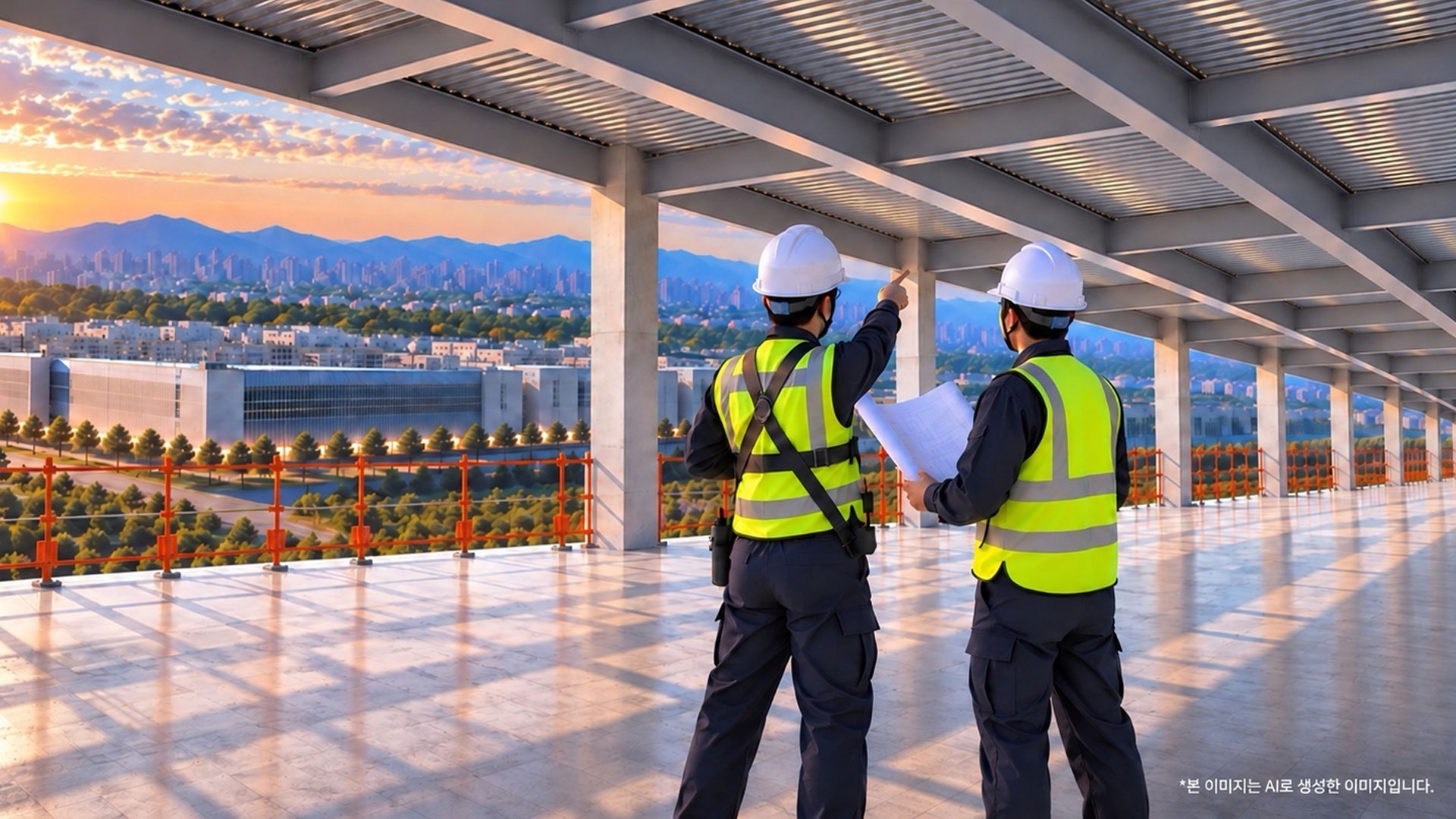
- Developed high-performance composite beam technology designed to support long spans and heavy loads in large-scale buildings while maximizing usable interior space.
- Enhanced construction safety and quality by minimizing on-site shoring and formwork and adopting off-site fabrication.
- Plans to expand the technology’s use in high-performance buildings, including data centers, leveraging its structural safety and constructability.
Hyundai E&C has developed a high-performance composite beam method designed to support heavy loads while reducing the number of structural columns required in large-scale buildings, allowing for more efficient use of interior space.
On Wednesday, Nov. 18, Hyundai E&C announced that it had secured a patent for the “HRT-Beam(Hyundai Reinforced Thin-Steel Composite Beam)” method, jointly developed with Hyundai Steel. The company also said that the Korean Society of Steel Construction(KSSC) had certified the seismic-resistant beam-to-column connection technology used in the method.
Composite beams combine the structural advantages of steel and concrete and are widely used in large-scale buildings that require long spans and the capacity to support heavy loads. As artificial intelligence expands and data centers house increasingly dense concentrations of equipment, the loads placed on building structures are rising, making structural performance and safety more critical than ever.
Unlike conventional composite beams, which require larger cross-sections and additional reinforcement to accommodate heavier loads, the HRT-Beam uses an optimized cross-sectional design to maximize structural performance. This allows it to safely support heavy loads while creating spacious, open interiors, making it particularly well suited to long-span, high-load structures such as data centers.
The HRT-Beam features internal ribs that keep its steel plates from deforming, along with reinforcing bars that allow the steel and concrete to act as a single structural unit. A key strength of the technology is that it maintains stable composite action between the two materials even under heavy bending and compressive loads. Working together, the ribs and reinforcing bars help absorb and dissipate seismic energy. This reduces the risk of sudden structural failure or excessive deformation during an earthquake and improves the structure's seismic performance.
Modern data centers must do more than bear the heavy loads of large numbers of servers and power supply equipment. They also need the structural integrity to keep operating stably during a disaster. The HRT-Beam is therefore regarded as a promising structural solution for keeping such high-performance buildings safe.
Hyundai E&C has secured a patent for the HRT-Beam construction method, which uses an innovative design to optimize material use and improve structural performance. The company also received technical certification from the Korean Society of Steel Construction(KSSC) for its seismic-resistant connection system linking HRT-Beams to steel-reinforced concrete(SRC) columns. The certification follows a series of performance evaluations, including full-scale seismic tests, which confirmed the system’s structural safety and earthquake resistance. The results are seen as establishing the technical reliability and a foundation for commercialization needed to deploy the system in actual construction projects.
The HRT-Beam method is also designed to improve construction safety and quality. By minimizing the need to install and remove temporary shoring and formwork, it reduces risks associated with working at heights and temporary construction operations. Major components are also prefabricated off-site, a process expected to improve construction safety, quality control and production efficiency.
“The HRT-Beam is a composite structural solution that brings together Hyundai E&C’s and Hyundai Steel’s expertise in steel and structural engineering,” an official at the HMG Construction Technology Research Center said. “By securing patents and technical certifications, we have strengthened our technological competitiveness across the entire process, from development and design to fabrication and construction.” “Building on the specialized capabilities of both companies, we will continue to develop advanced structural solutions for high-performance buildings, including data centers, while strengthening our competitive edge by combining expertise in construction and materials technology,” the official added.
The HMG Construction Technology Research Center, a joint research and development organization of Hyundai E&C and Hyundai Engineering, is also expanding its portfolio of off-site construction(OSC) technologies, including the HRT-Beam system, precast concrete(PC) Rahmen structure, and structural wall systems. By obtaining technical certifications for these technologies, the center is verifying their performance and reliability while strengthening its core capabilities in OSC, which encompasses the entire process from design and fabrication to on-site assembly and construction.