- Series
A New 30 Years Begins for Hyundai in India: Introducing Pune Plant
- Hyundai Motor Company
- 2026.10.23
- 분량10min
- 조회수 237Views
AI summarized the main points
AI-generated summary. Please refer to the full article for precise details.
- Rebuilt for a New Era of Smart Manufacturing
- A Two-Pillar Production Setup: South and West
- From First Press to Final Approval: Following the Process
- The Press Shop: Where Body Panels Take Shape
- The Body Shop: Precision Welding by Robots
- The Paint Shop: Where Lighting Adapts to Color
- The Assembly Shop: Where a Car Is Completed
- Managing Electricity, Water, and Waste
- Hyundai Motor’s Next Chapter Starts in India
2026 marks the 30th anniversary of Hyundai Motor’s entry into the Indian market, which began with the establishment of a local subsidiary in May 1996. Building on three decades of growth, Hyundai Motor India Limited held the inauguration of its new Pune plant on October 14, a milestone on the road to the next 30 years.
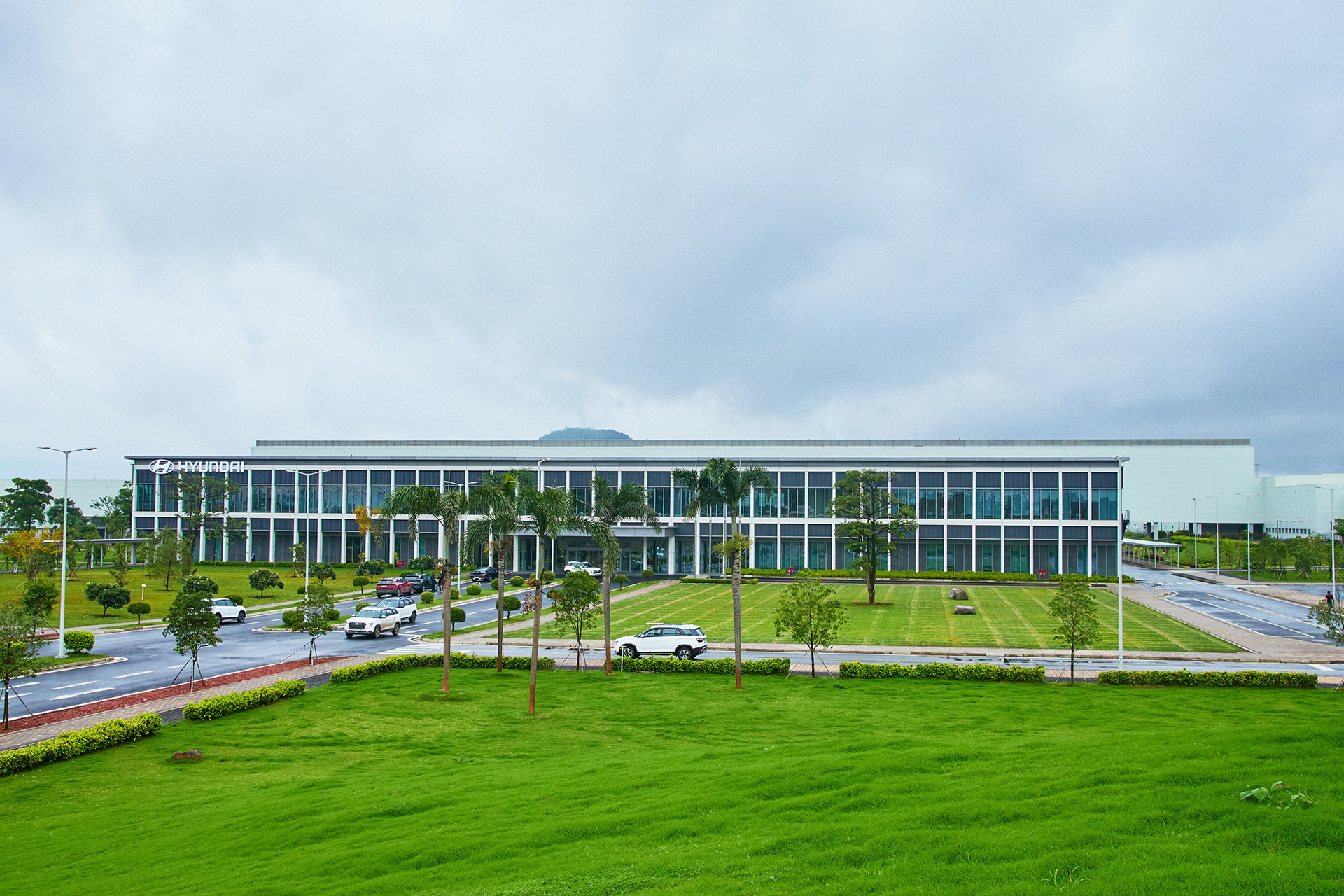
Located in Pune, western India’s auto hub and a key crossroads for transportation and logistics, the plant is a core forward base for Hyundai as it prepares for the shift to electrification in India and strengthens its position as a global export hub. This article looks at how the Pune plant came to be, its advanced automation equipment and smart manufacturing systems, and the full process for building an entire car there.
Rebuilt for a New Era of Smart Manufacturing
The Pune plant has its roots in the Talegaon plant that General Motors (GM) established. After the company halted production in 2020 and withdrew from India, the plant sat idle, with no new owner.
The turning point came in 2023. That year, Hyundai Motor completed the purchase of the plant's land, buildings, and production equipment from GM India. Rather than tear the plant down and start over, Hyundai kept what could still be used and added what was needed. It made active use of some of the existing equipment, while bringing in Hyundai Motor Group assets previously operated in other regions and optimizing them for the site. As a result, the plant was ready for mass production less than two years after the acquisition.
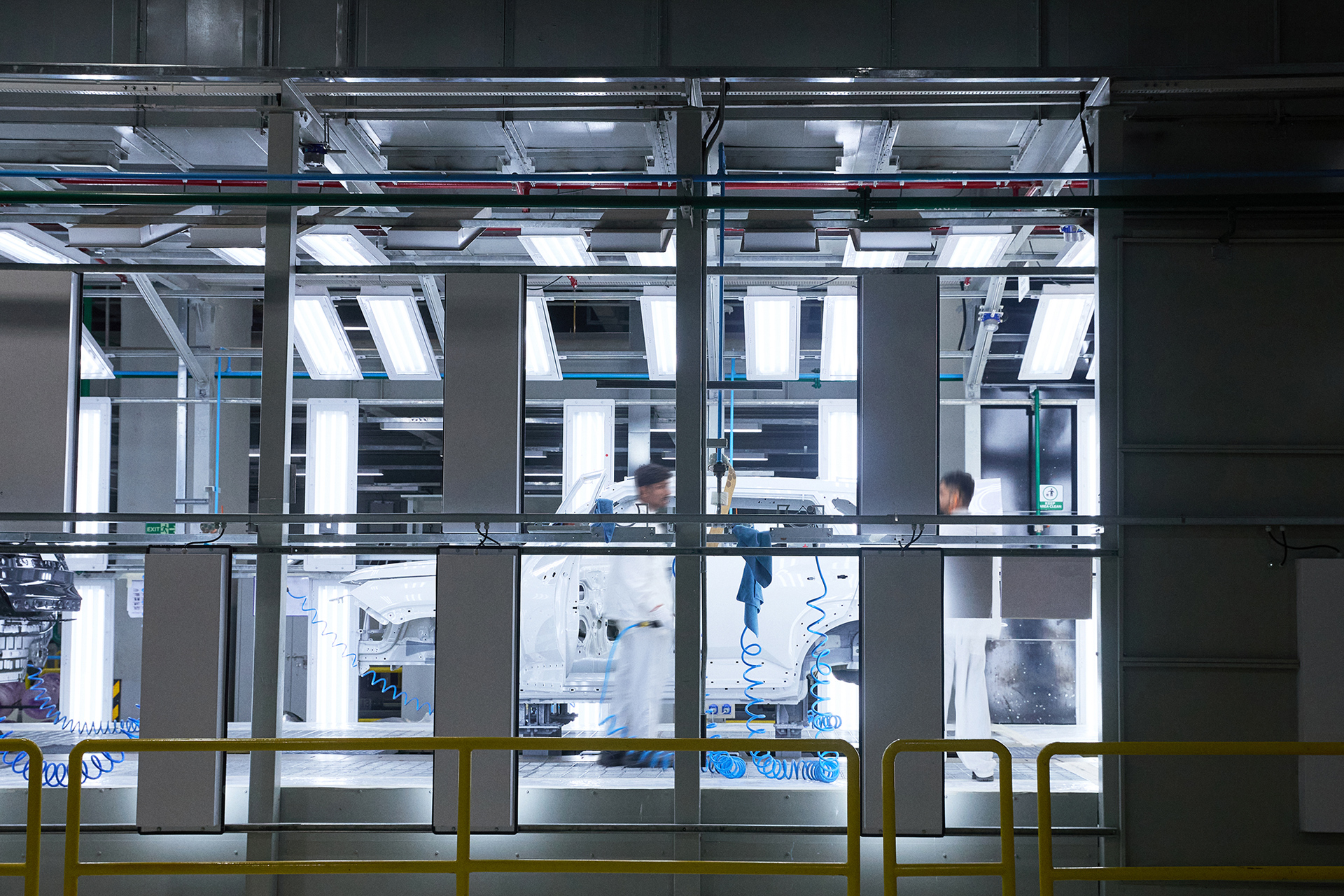
After the rebuild, the plant began engine production in June 2025 and moved into full-scale vehicle production that October. Its annual production capacity is 170,000 units. The first vehicle to enter mass production was the second-generation compact SUV, the all-new Hyundai VENUE. Cars built here are reaching not only Indian customers but also customers in markets including Mexico, Chile, South Africa, and Saudi Arabia, with plans to expand exports to more than 30 countries.
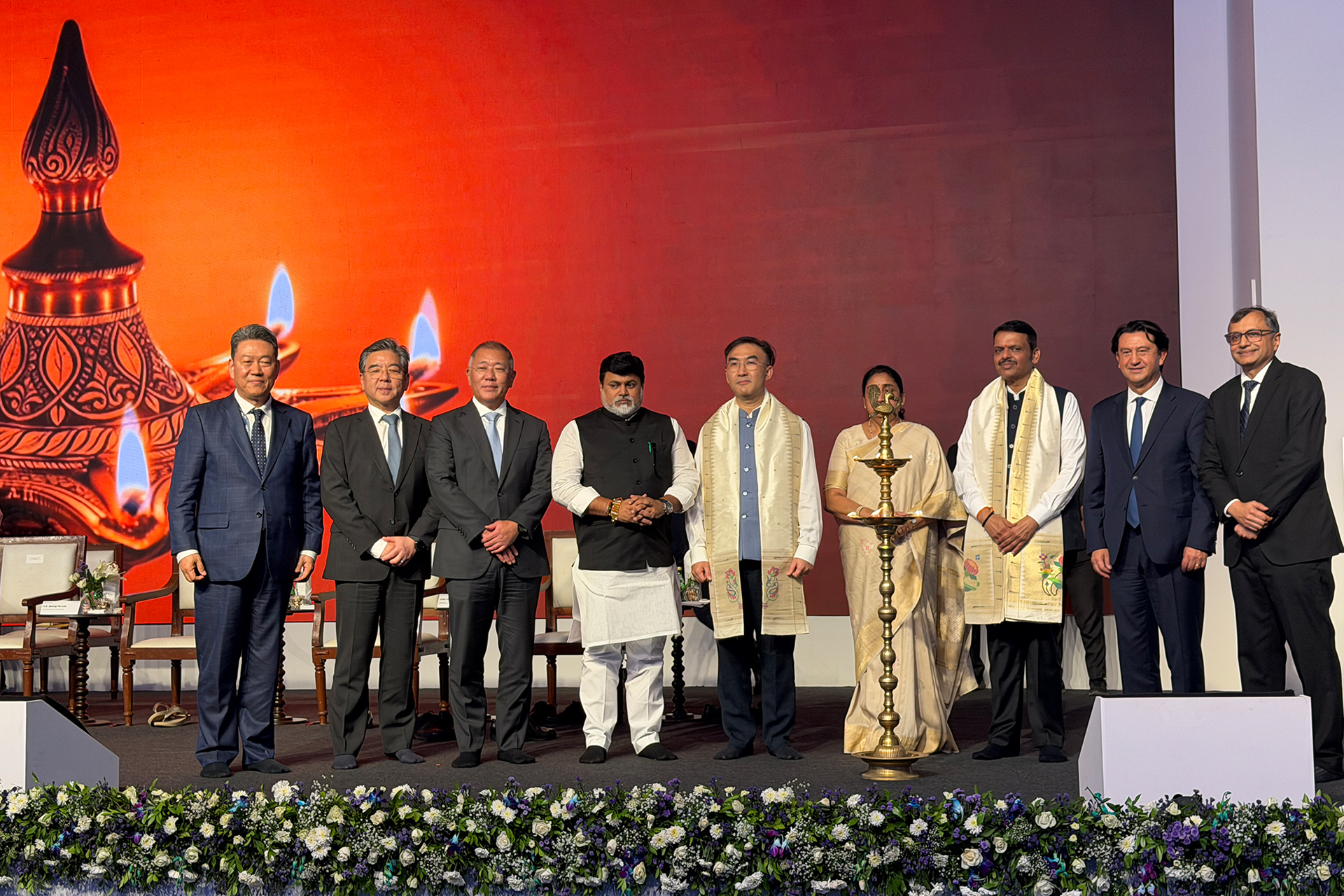
The ceremony was attended by Devendra Fadnavis, Chief Minister of Maharashtra; Sunetra Ajit Pawar, Deputy Chief Minister of Maharashtra; and Ambassador Seongho Lee of the Republic of Korea to India, along with other political and government officials from both countries. Representing Hyundai Motor Group were Executive Chair Euisun Chung; Vice Chair Jaehoon Chang; José Muñoz, President and CEO of Hyundai Motor Company; and Tarun Garg, Managing Director and CEO of Hyundai Motor India Limited (HMIL).
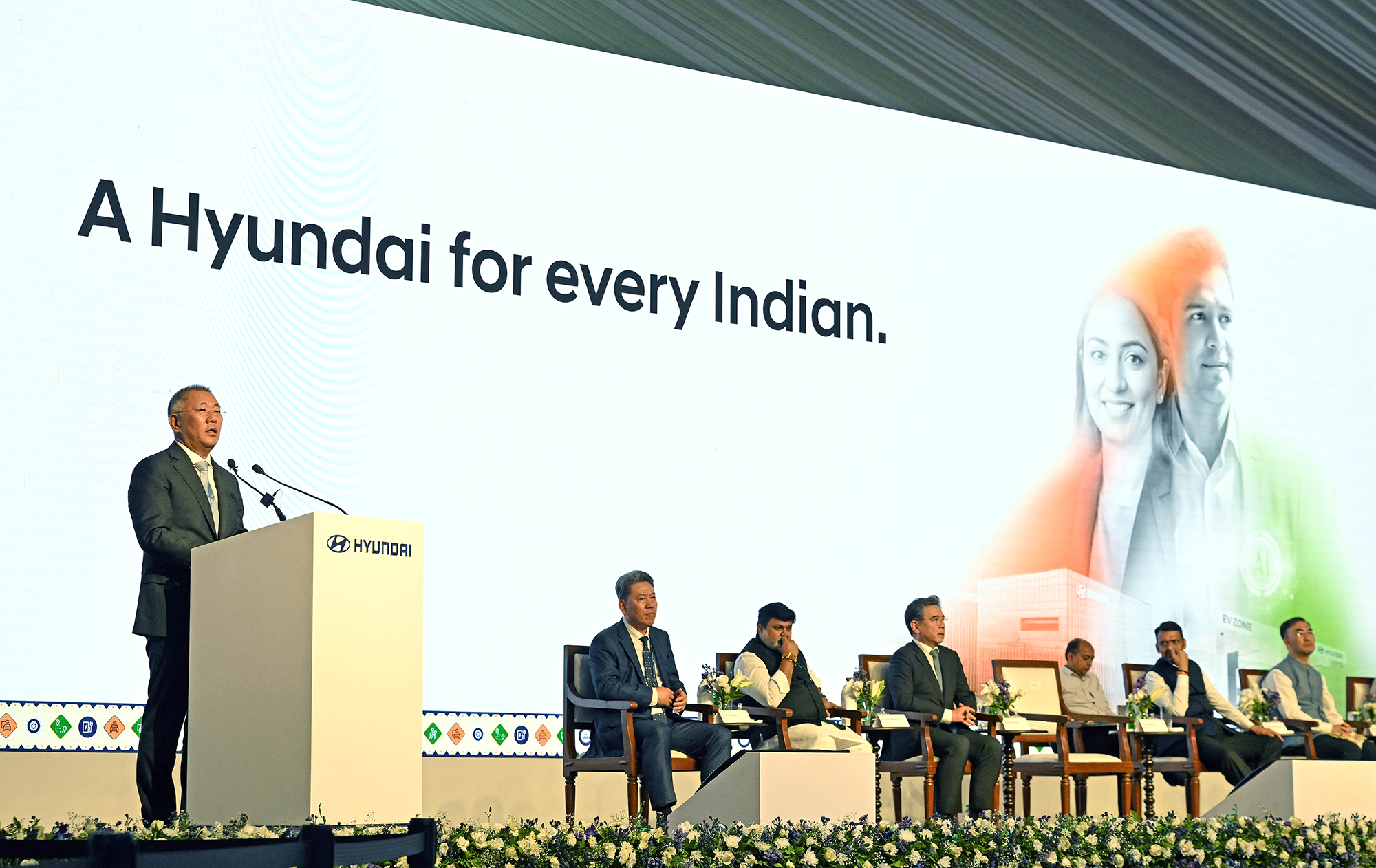
In his welcome address, Chair Chung reflected on the Group’s time in India: "From the moment we first entered India 30 years ago, Hyundai Motor has worked to earn the trust of local customers. Since we launched the SANTRO, our first model here, India has become a core pillar of Hyundai Motor’s global growth," he said. He added that "the Pune plant inauguration marks the opening of a new chapter for Hyundai Motor in India," voicing his expectations for the new plant.
A Two-Pillar Production Setup: South and West
The completion of the Pune plant is a major change to Hyundai Motor's production setup in India. Hyundai Motor's Chennai 1 and 2 plants in the south have an annual production capacity of 824,000 units. With the Pune plant in the west added, annual capacity comes to nearly 1 million units. The two sites have different roles as well: with the Pune plant taking on production of the All-new Hyundai VENUE, the Chennai plants can focus more on the shift to electric vehicle (EV) production.
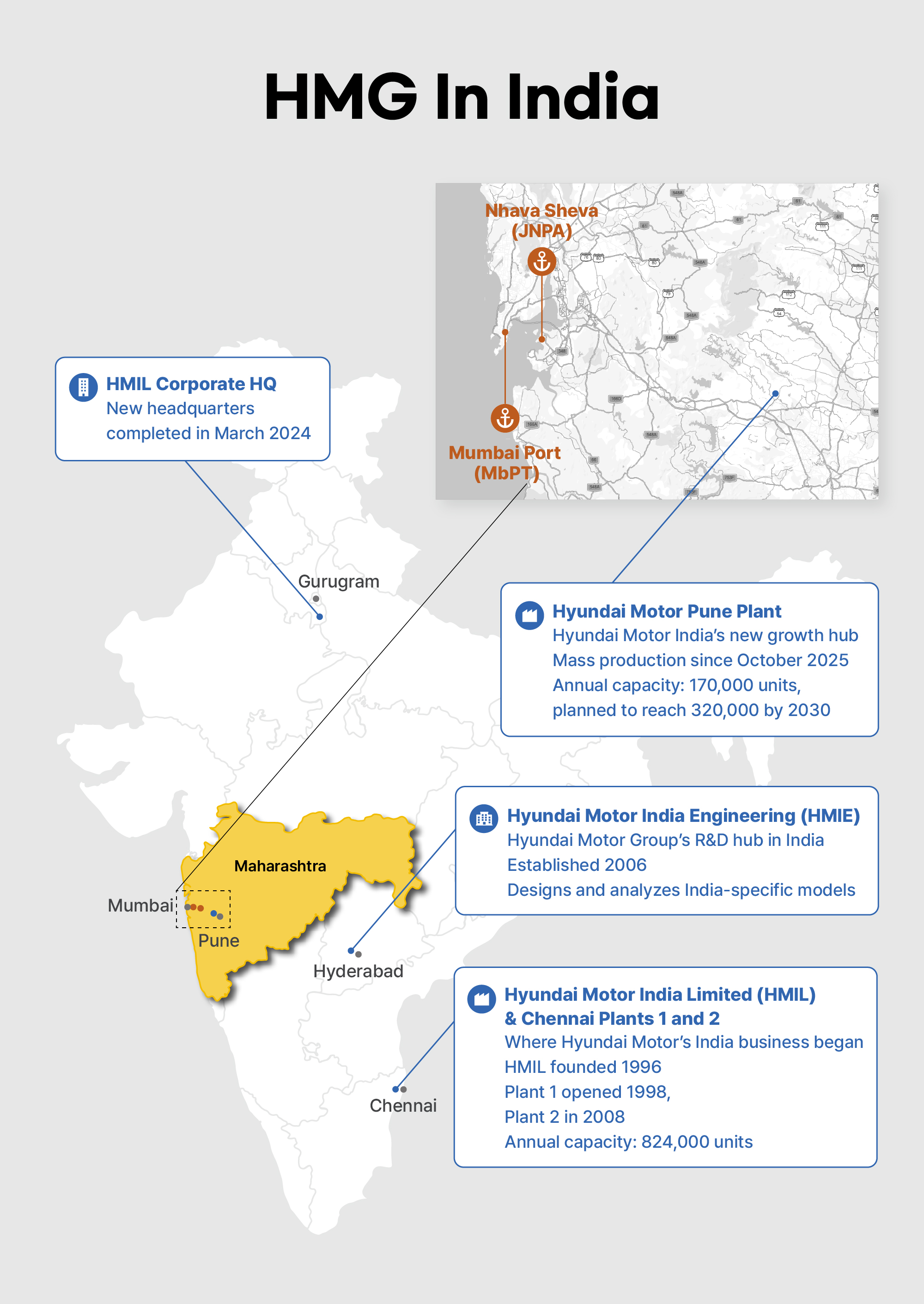
Splitting production between the south and west also improves the stability of logistics and the supply chain. Maharashtra state is one of India’s major automotive regions. Pune alone has thousands of manufacturing and parts companies supporting the auto industry, forming a dense supply chain that has earned it a reputation as India’s largest auto hub. Major ports, including Mumbai Port and Nhava Sheva Port, one of India’s leading container ports, are also nearby, allowing the plant to respond quickly to both domestic and export markets. That is why Pune is drawing attention as a production base aimed at global markets beyond India.
From First Press to Final Approval: Following the Process
The Pune Plant project investment was USD 724 million to secure an annual production capacity of 170,000 units. Rebuilt on a site of about 1.2 km² (roughly 166 soccer fields), the plant houses a vehicle plant covering the press, body, paint, and assembly shops; an engine plant with a capacity of 150,000 units a year; a test track; and employee training facilities. About 4,700 people work here, and new hires learn their tasks in advance through augmented reality (AR) training before stepping onto the line.
The plant is designed to build multiple models and powertrains on a single line, so it can flexibly change which models it produces in response to market demand. Hyundai Motor plans to add hybrid electric vehicle (HEV) production to broaden its capacity.
A common approach runs throughout the plant. Building on existing equipment and processes, it supplements inspections, safety checks, and model changeovers that once relied on human eyes and hands with data and automation. Here is a summary of the key production stages, from the press shop to final inspection approval.
The Press Shop: Where Body Panels Take Shape
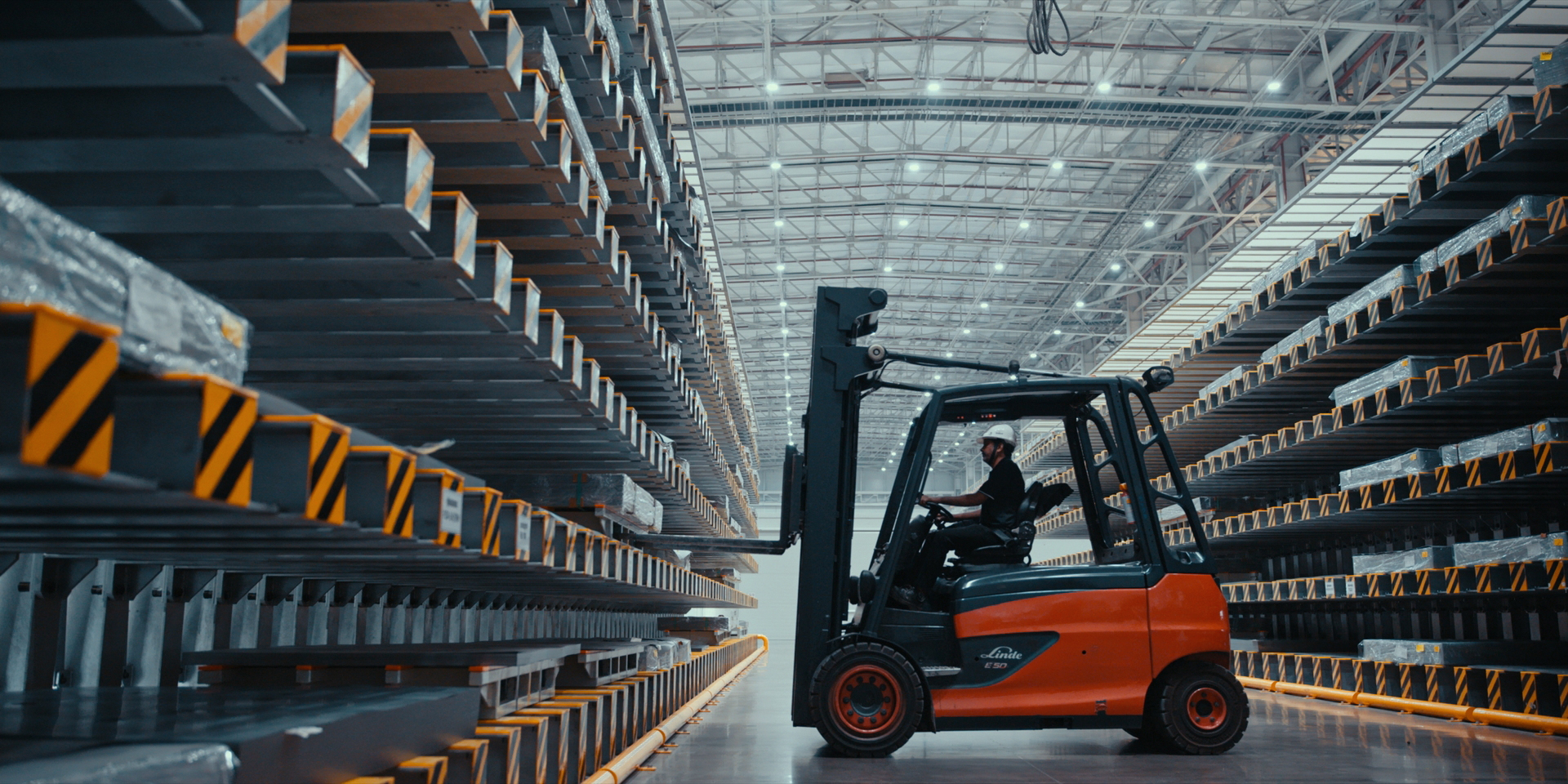
A car’s journey begins in the press shop. Here, a 5,400-ton press line stamps steel sheets into the body panels that will become the VENUE’s exterior and frame. The shop can turn out enough panels for 230,000 vehicles a year.
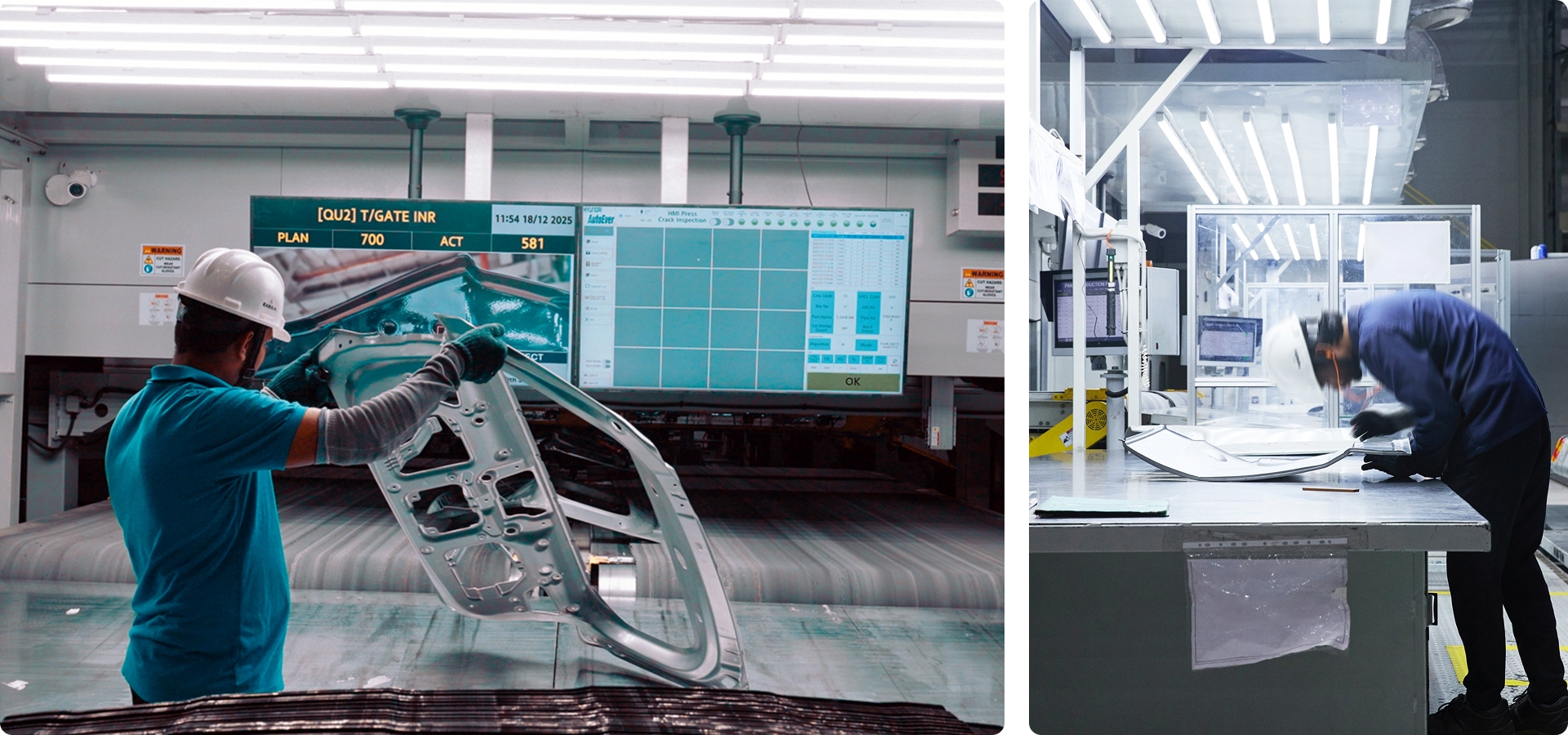
What stands out in the press shop is the introduction of AI. In the past, quality inspection meant workers searching for cracks on panel surfaces by eye and by hand. Now an AI-based panel crack detection system shares that work. Using infrared (IR) sensors together with camera vision inspection, it automatically catches even fine cracks and surface defects, helping safeguard panel quality.
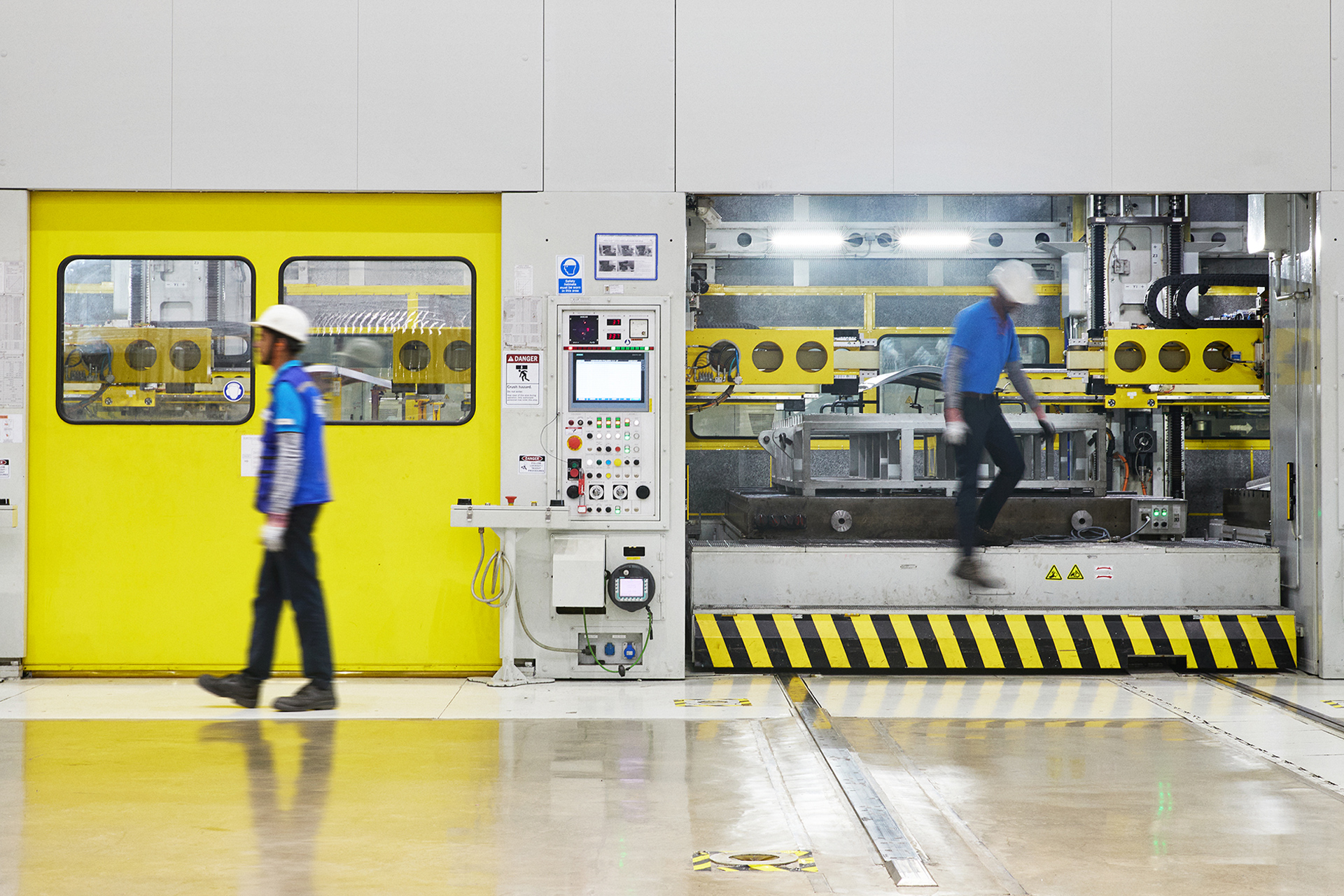
AI is also used for worker safety. In large presses that crush steel with tremendous force, making sure no one is inside the line is critical.
The Pune plant has handed this process over to AI cameras. Cameras at each entrance count +1 for each person entering and −1 for each person leaving. When the headcount inside the line reaches zero, the system automatically closes the doors and safety shutters, and only then does the press start to move.
The Body Shop: Precision Welding by Robots
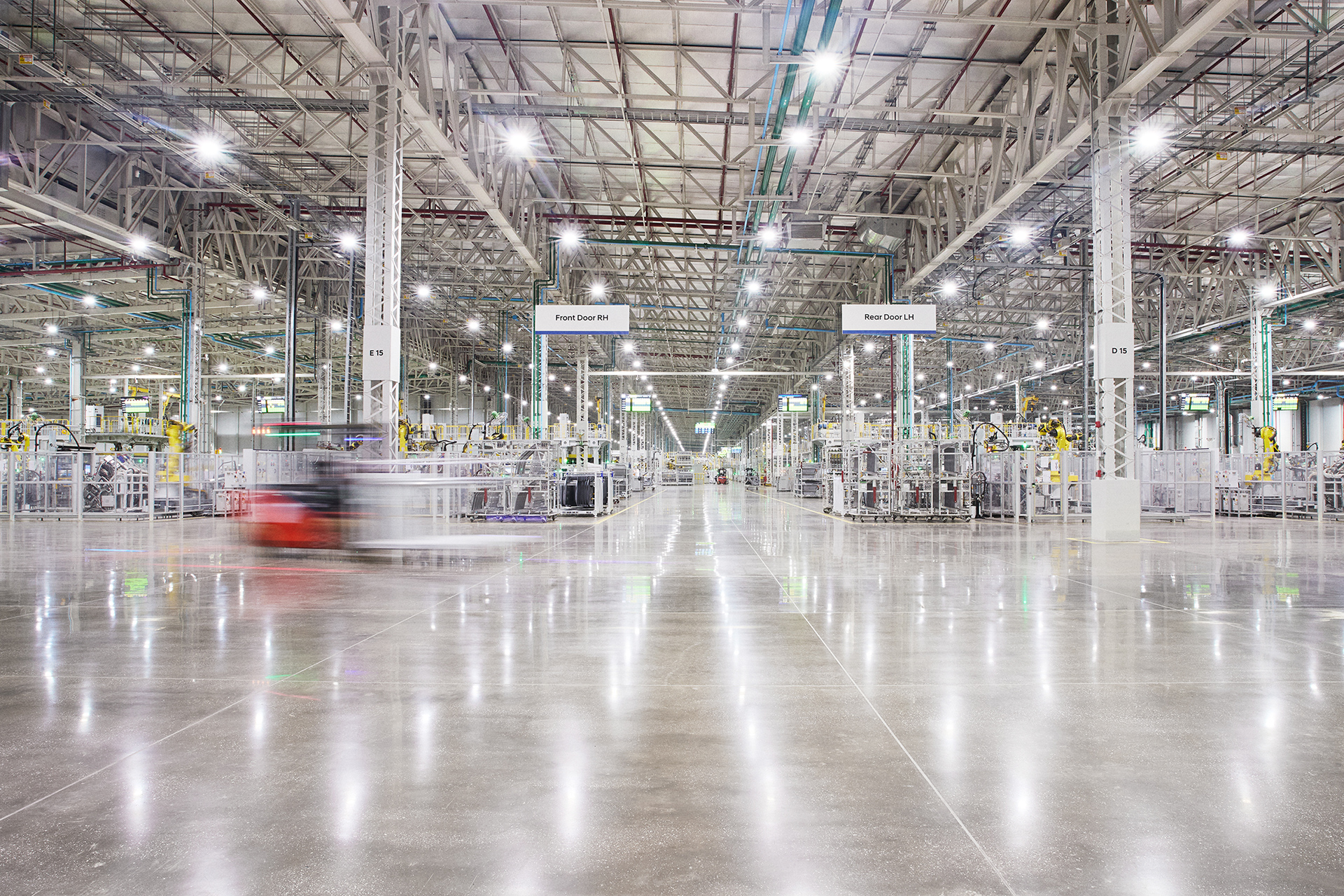
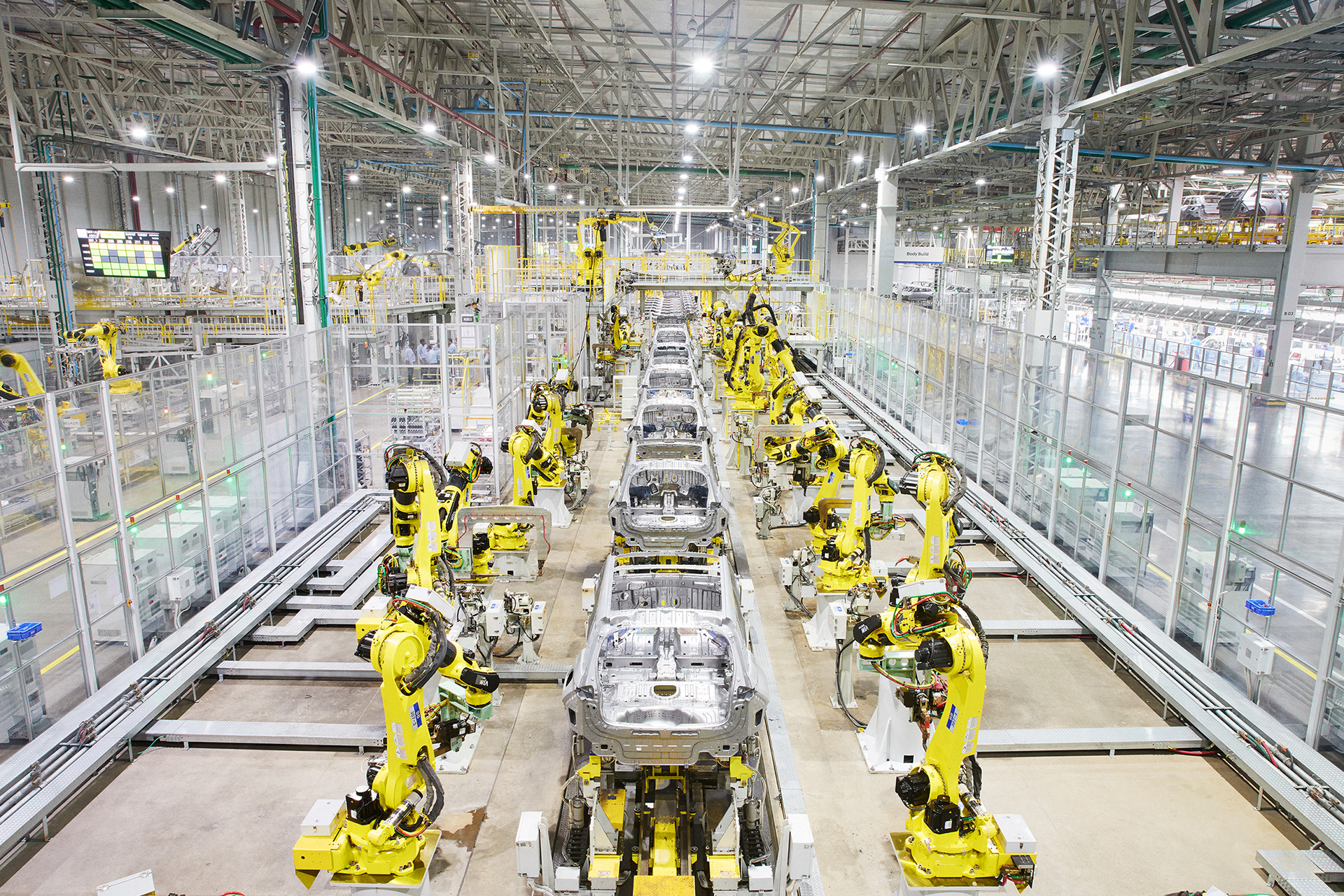
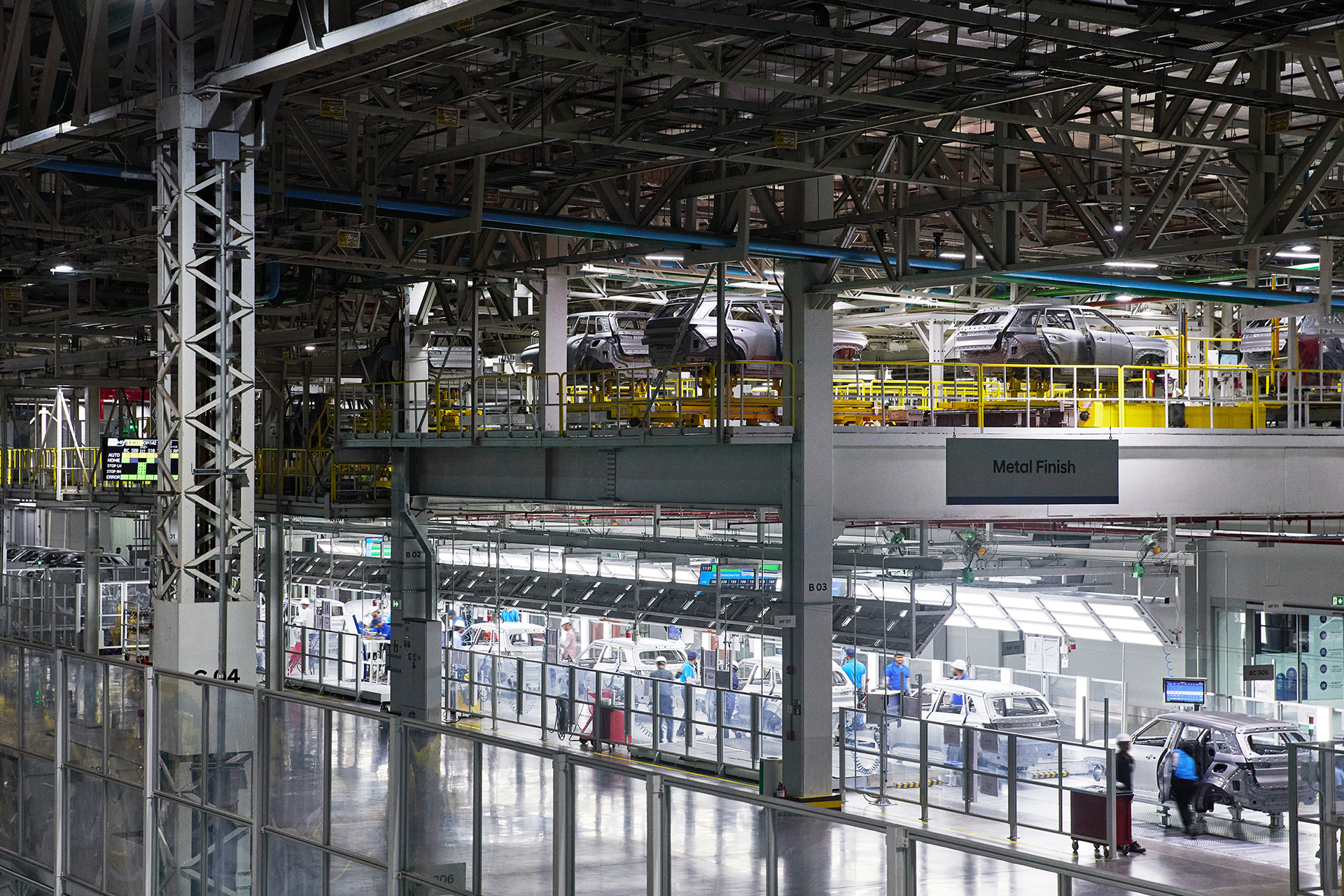
Panels from the press shop then move to the body shop, where they are joined into a single body that forms the car’s frame and exterior. More than 200 industrial robots handle all of the welding. Loading heavy, large panels onto the line is now done by automated equipment as well.
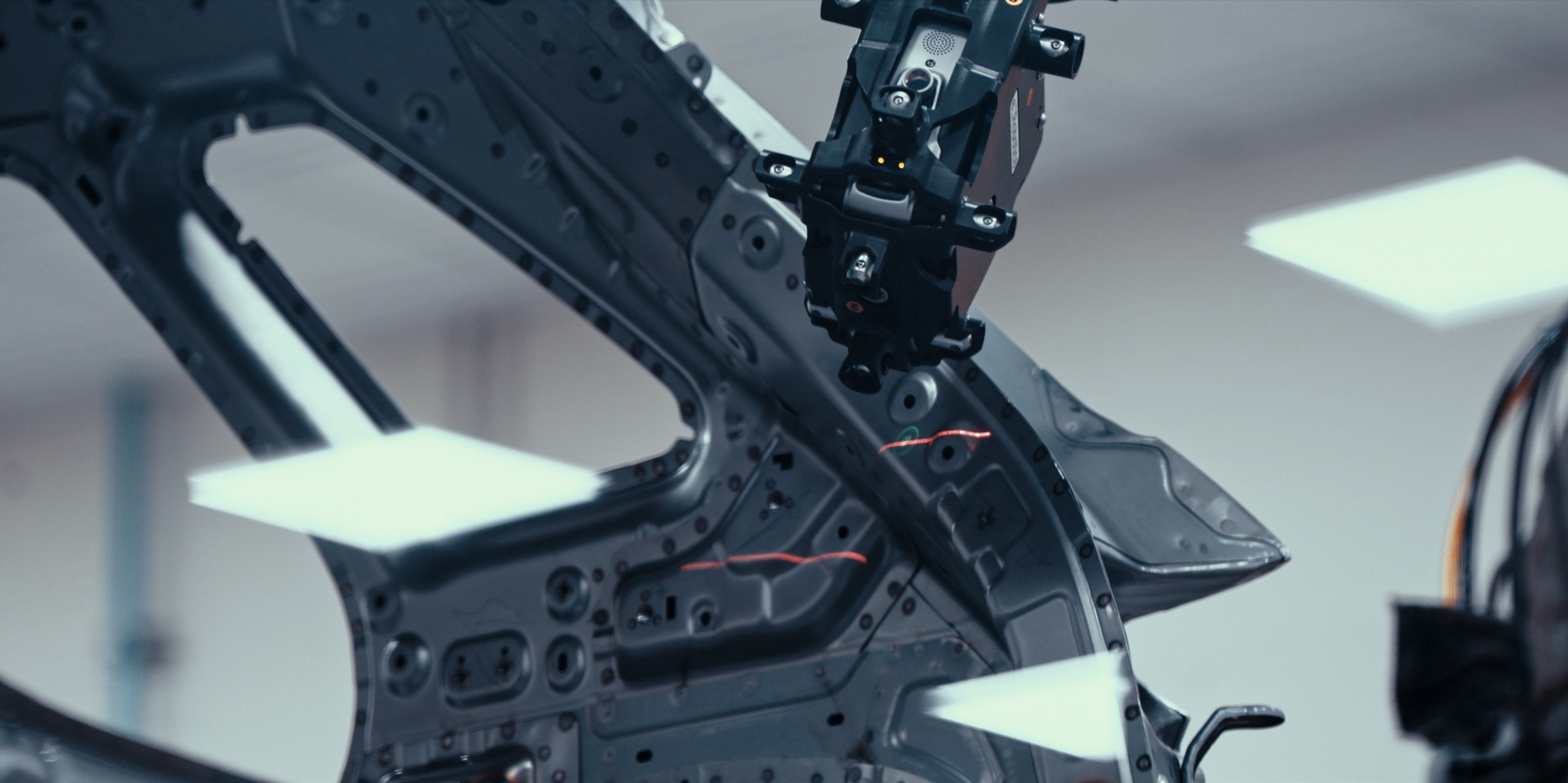
With machines taking over tasks that once weighed heavily on workers, the shop has improved both efficiency and on-site safety. Once welding is complete, each body-in-white (BIW) is scanned in 3D across its entire surface to confirm that nothing deviates from the design.
The Paint Shop: Where Lighting Adapts to Color
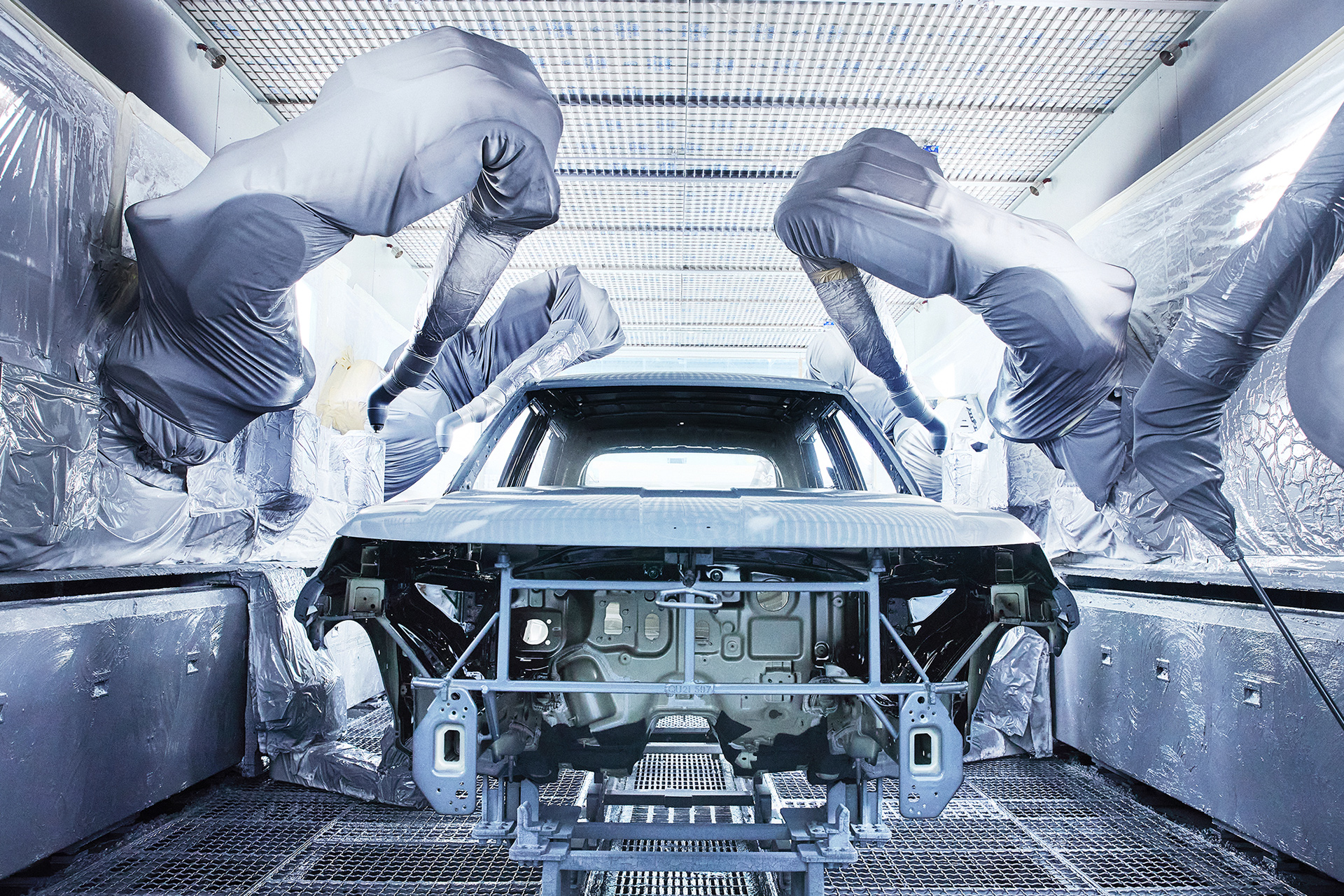
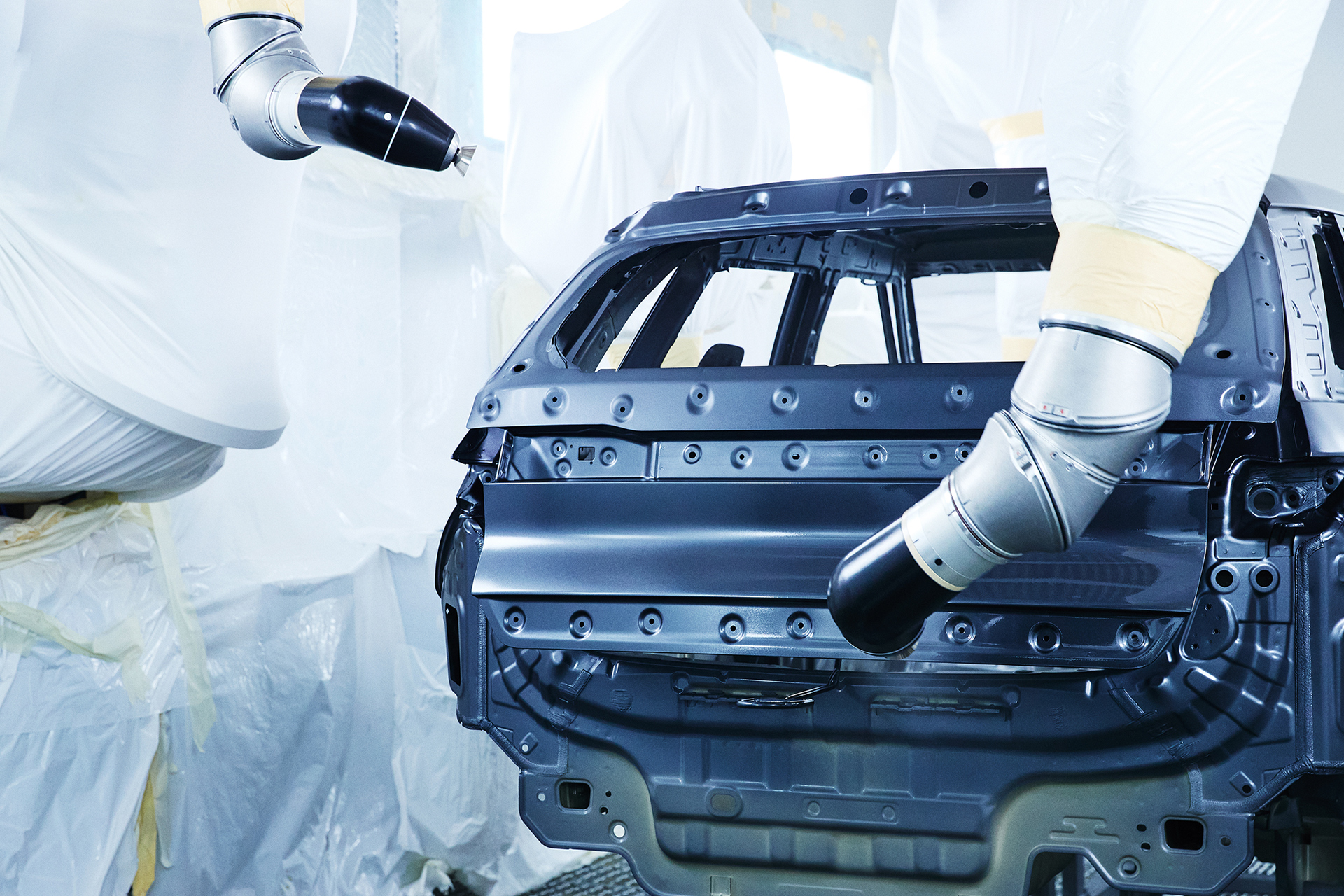
Next is painting. Bodies entering the paint shop go through pretreatment to remove contaminants, electrocoating to prevent corrosion, and sealing to ensure water tightness, in that order. Robots then complete the exterior using a "3-coat, 2-bake (3C2B)" method: three coats of paint and two bakes. Two-tone paint with a different roof color is also possible.
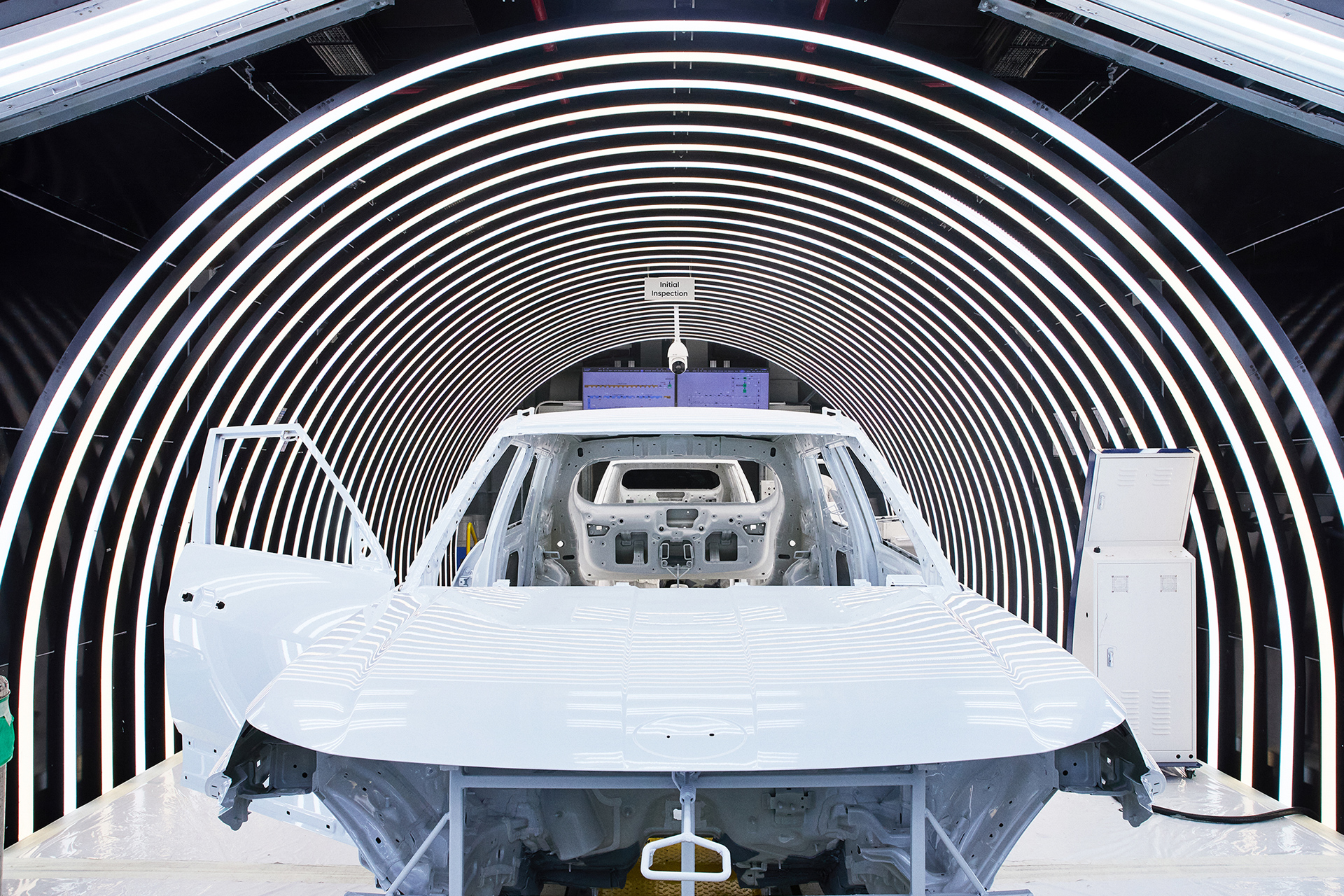
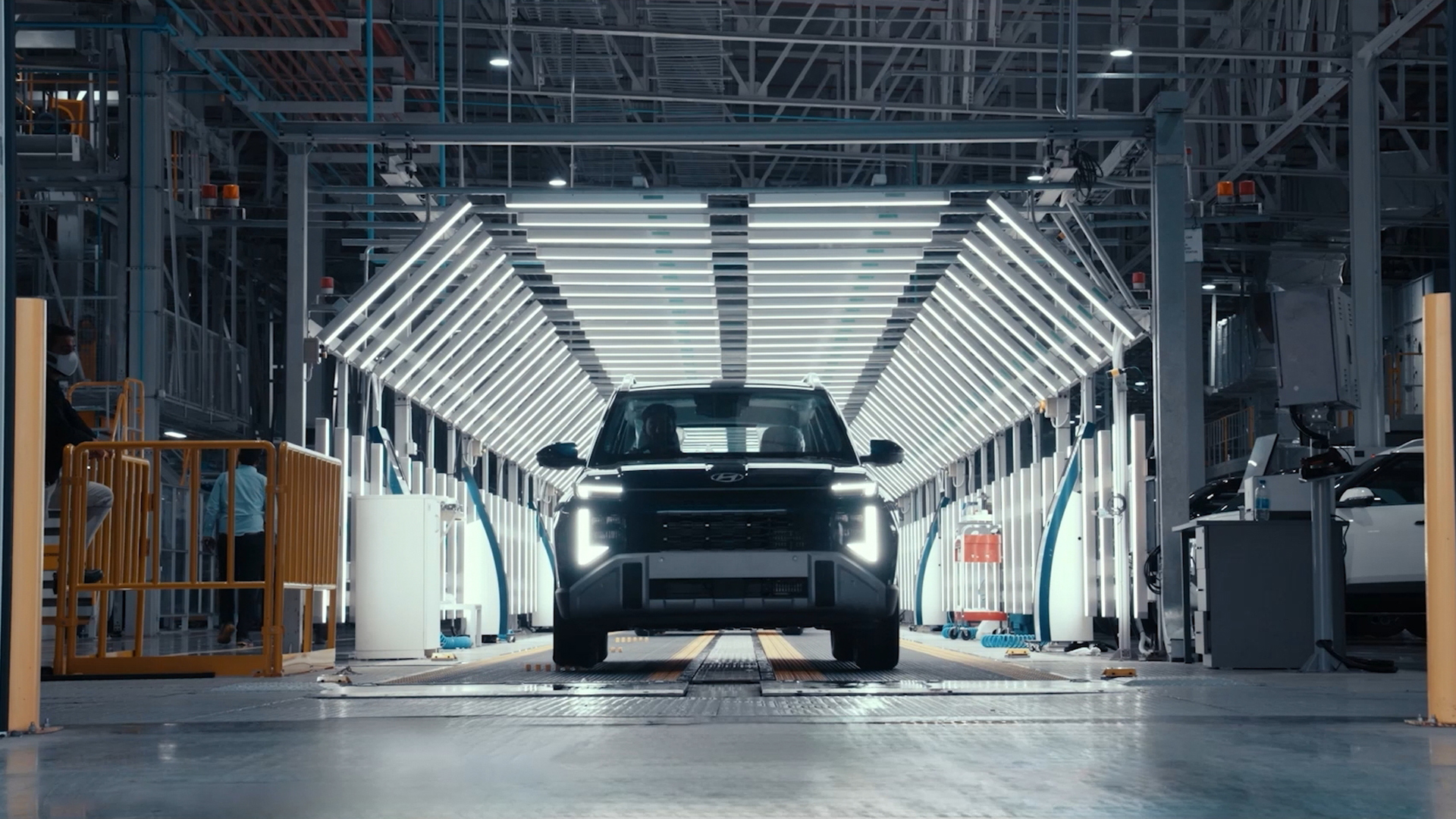
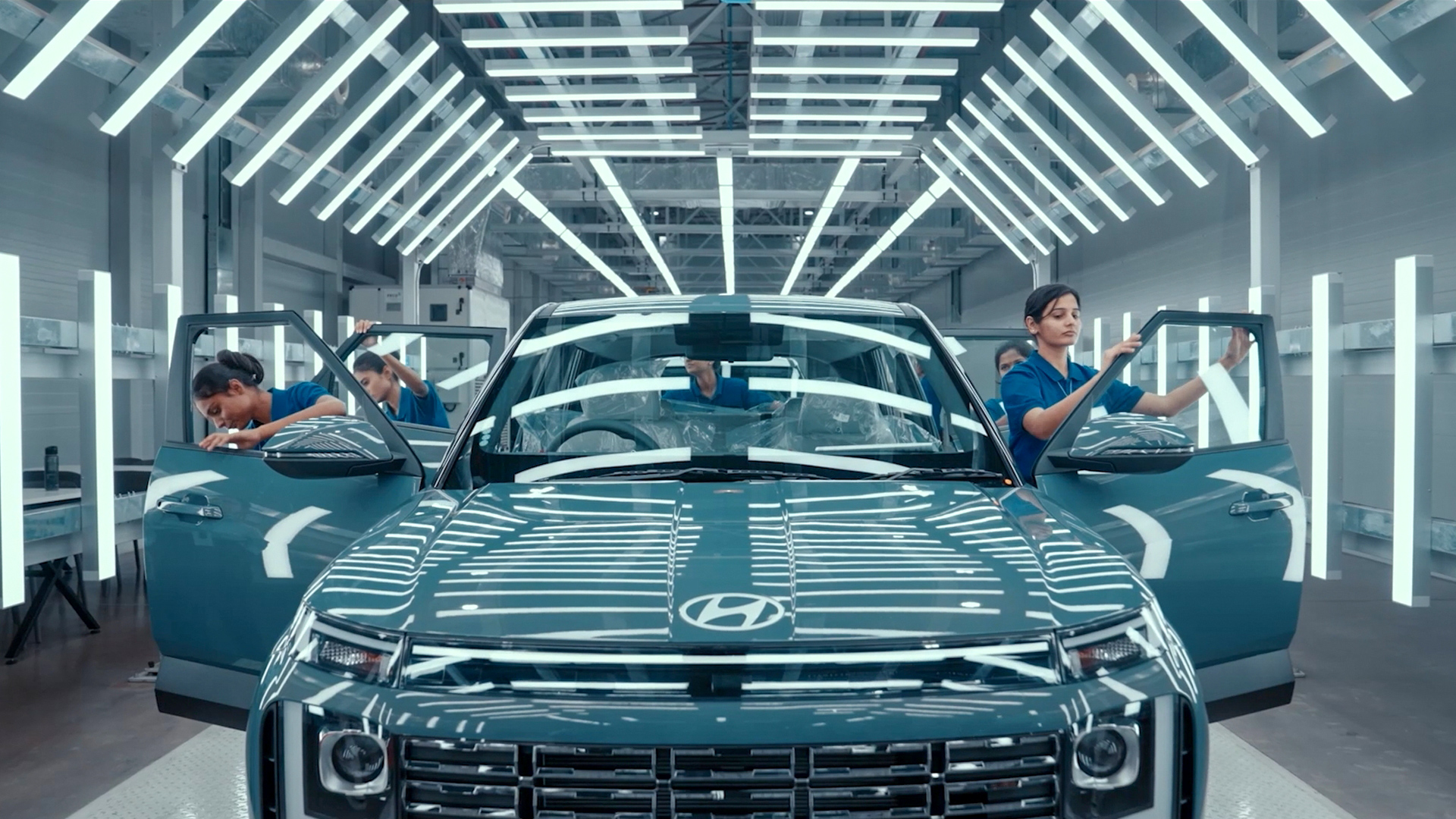
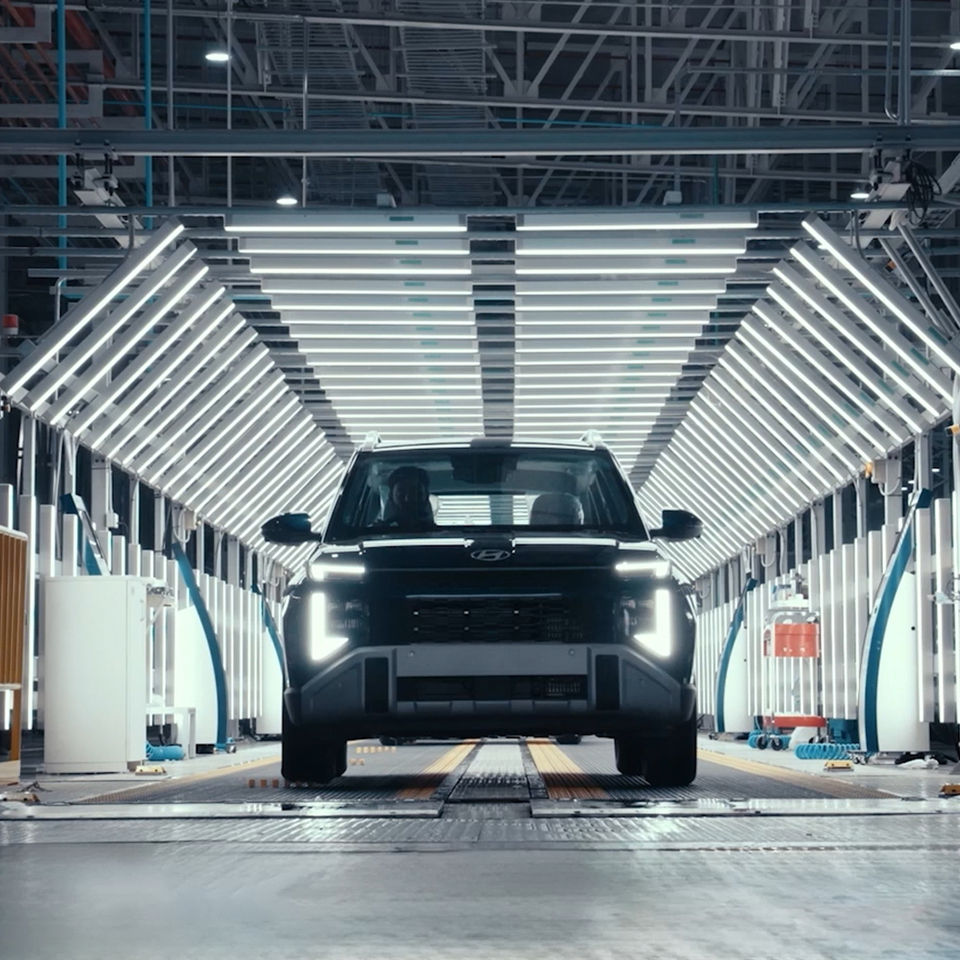
Painted bodies go through a final inspection at the end of the paint process. As a body passes under smart lighting arranged in a tunnel-like arch, the lights automatically adjust their brightness to the vehicle’s color: dimmer for light-colored cars and brighter for dark ones, so that even minor flaws stand out. Workers can examine the painted surface closely under this lighting, with less eye strain. Every car body must pass this inspection before moving on to the assembly shop.
The Assembly Shop: Where a Car Is Completed
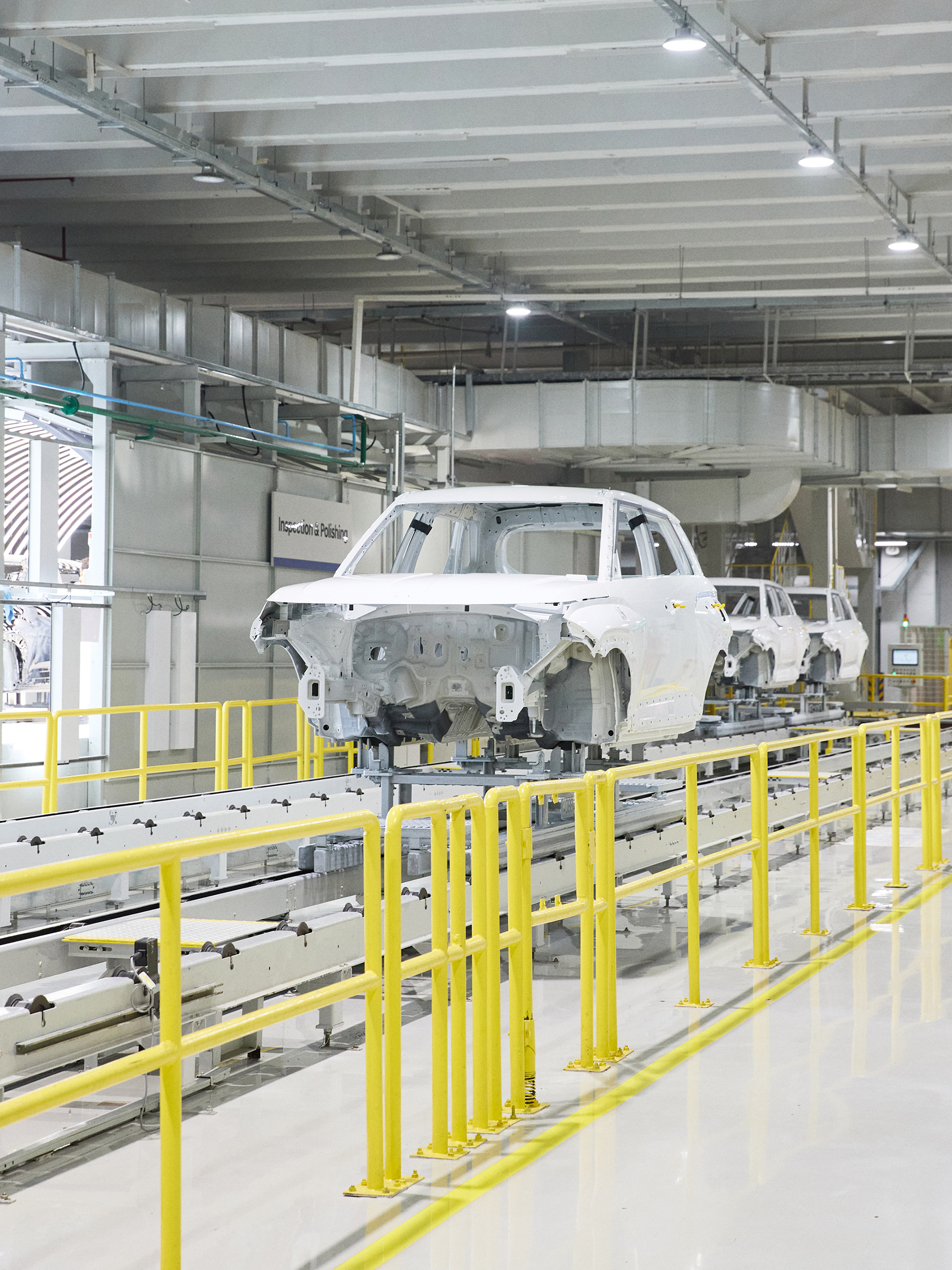
Painted bodies then enter the assembly shop, the final stage of production. Here, countless parts are added one by one until the body finally takes the shape of a finished car.
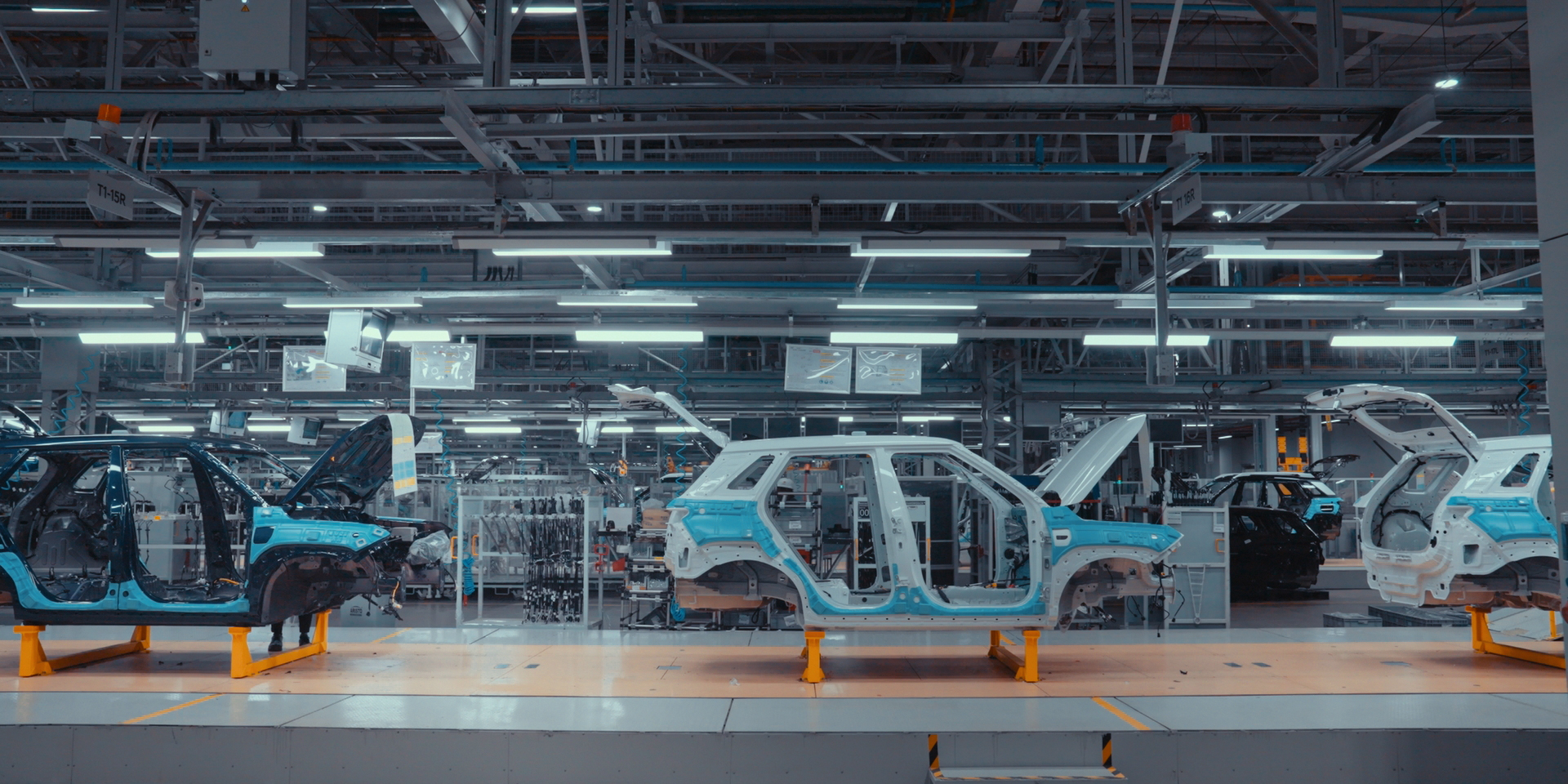
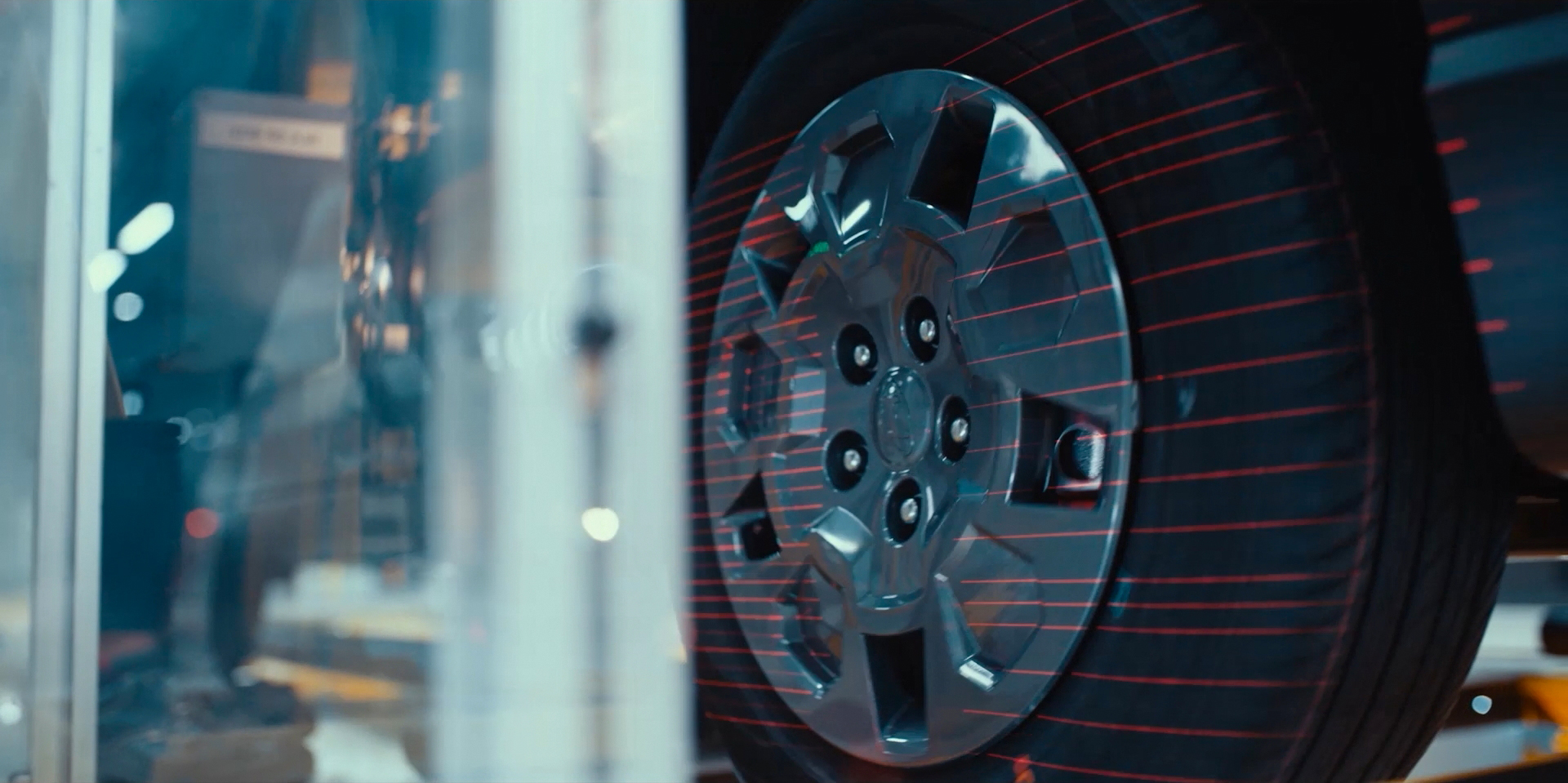
For now, only the all-new Hyundai VENUE moves down this line, but the line is set up flexibly to handle mixed production of multiple models in the future, such as C-segment SUVs and hybrids. Work tools carry smart tags that automatically record which car was worked on with which tool. The tags also exchange vehicle information with production equipment in real time, heading off assembly errors before they happen.
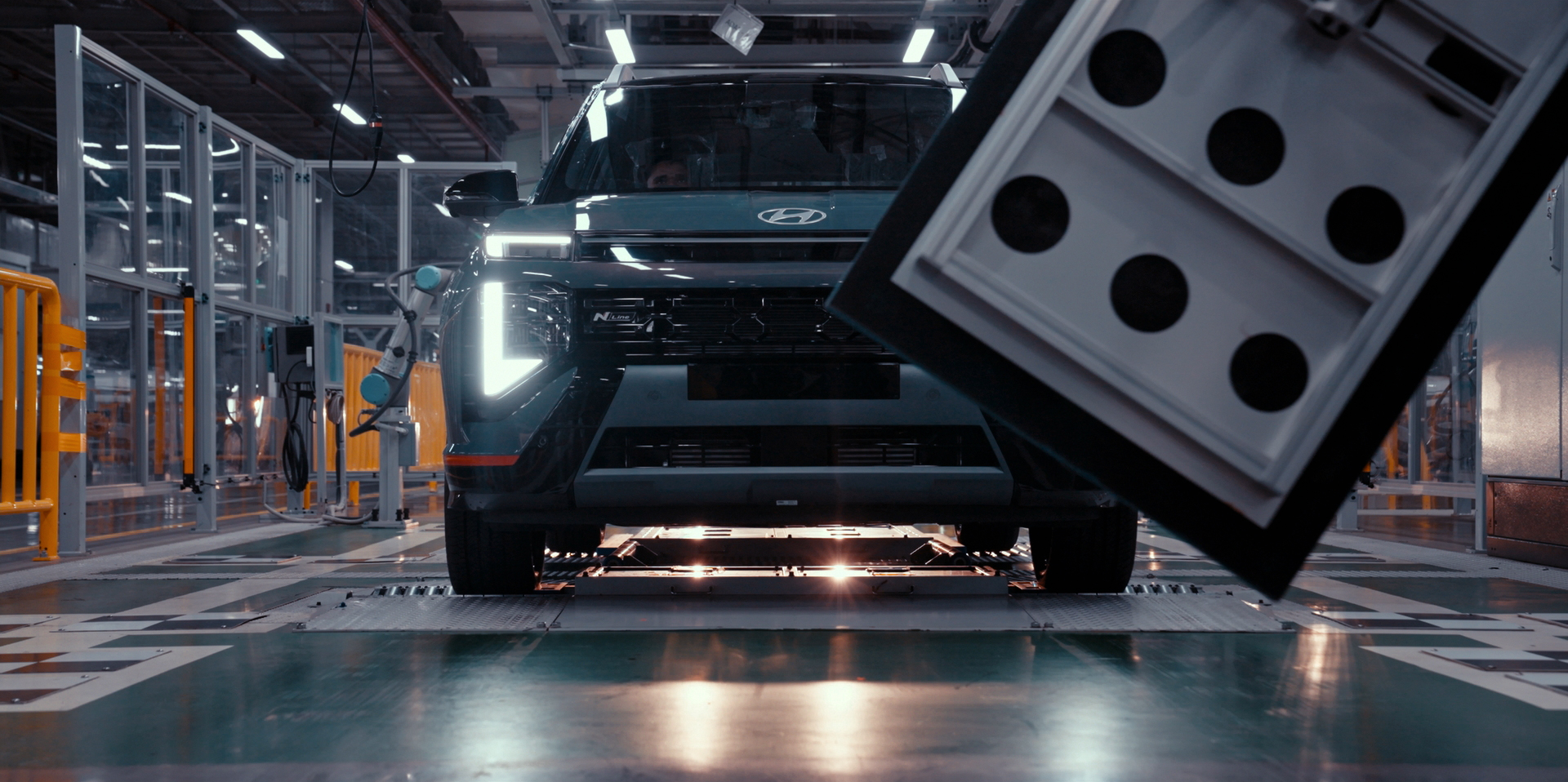
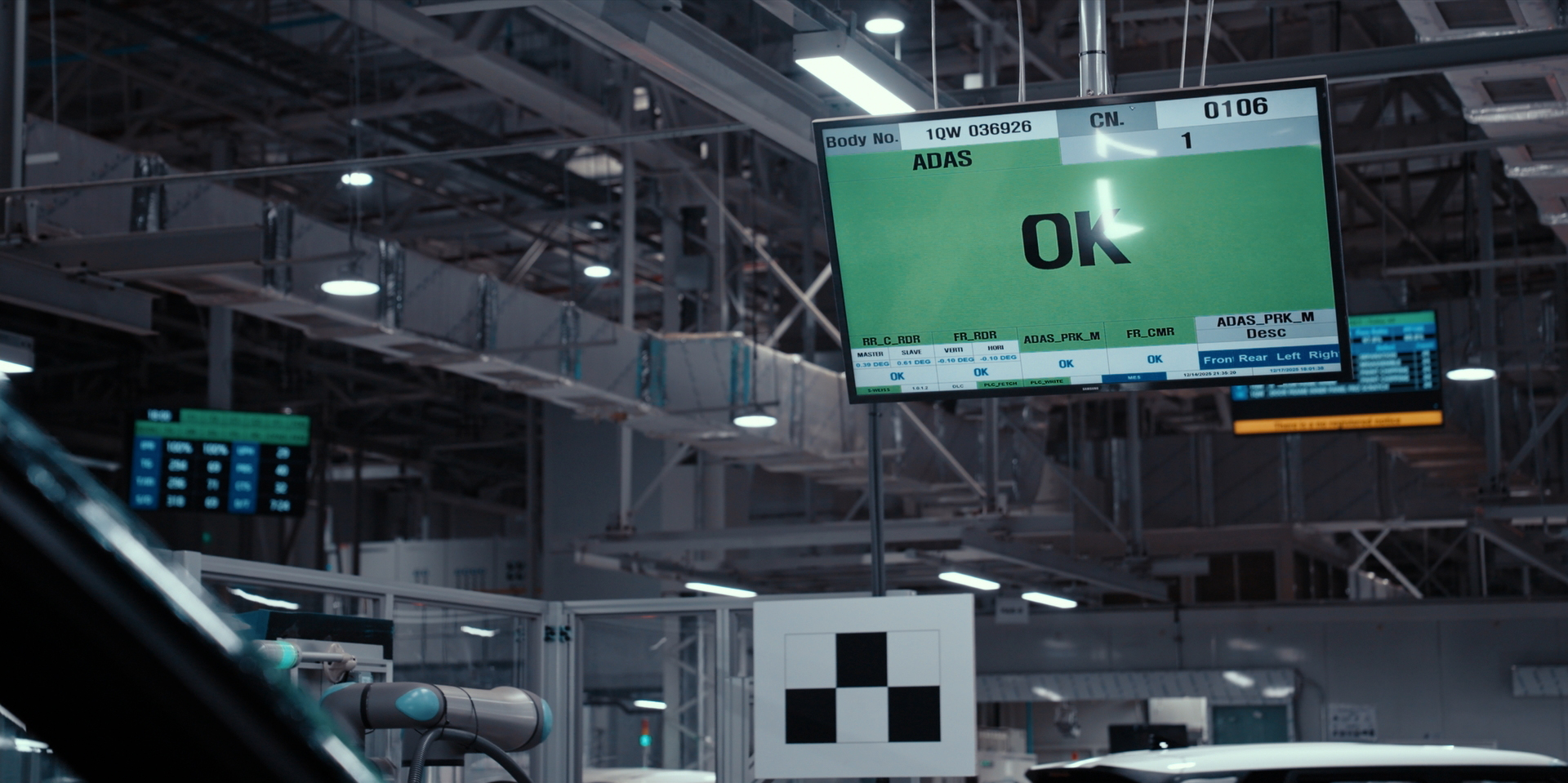
Advanced driver assistance systems (ADAS), such as lane keeping and smart cruise control, work properly only when their sensors are aimed in exactly the right direction. At Pune Plant, an ADAS calibration system precisely adjusts the angle of each vehicle’s radar sensors.
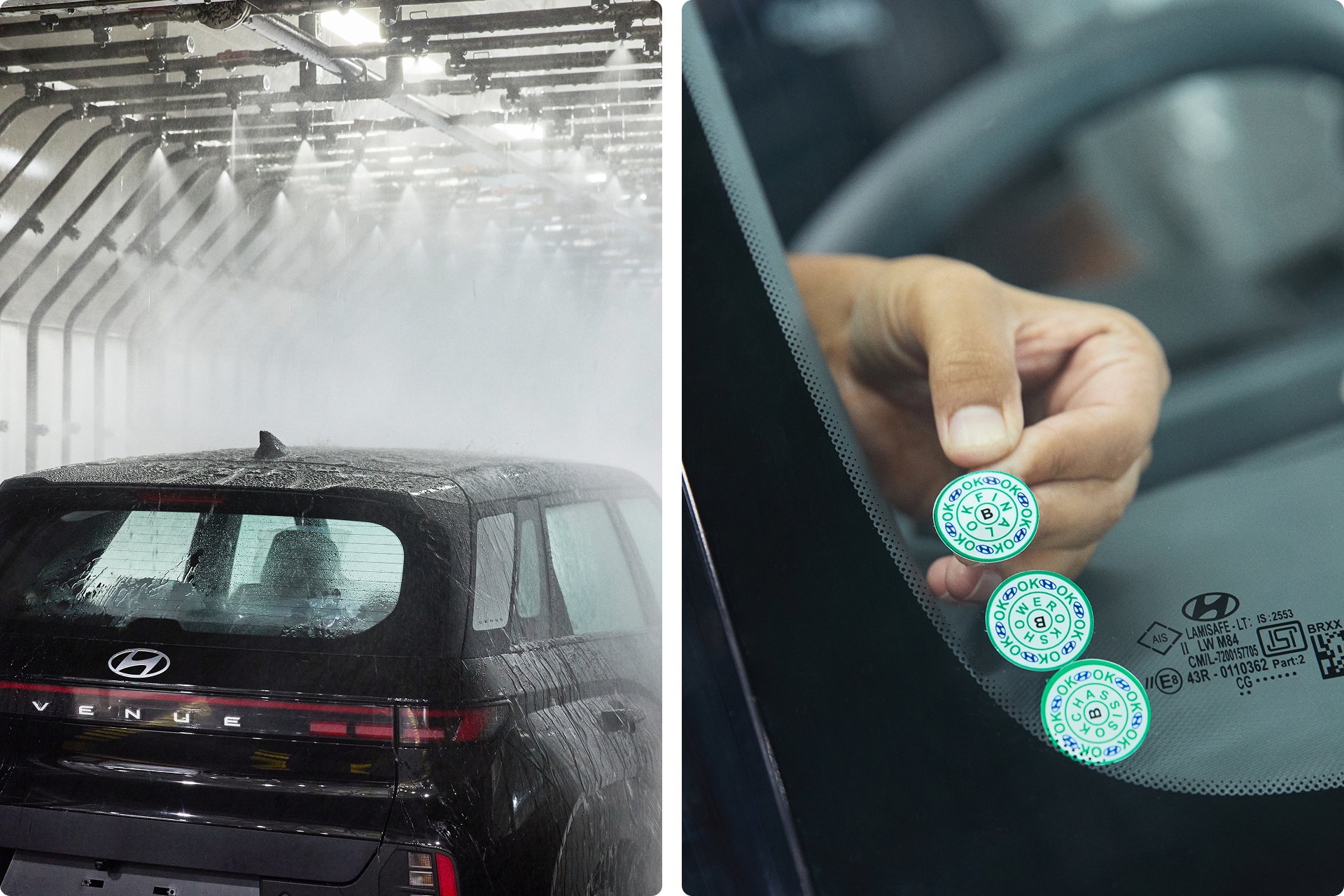
After assembly, each car goes through final inspection, the last gate before it leaves the plant. A shower test checks whether water can get into the vehicle, followed by a function and performance test covering engine start, steering, and braking, and an exterior inspection of the paint and body assembly. Once all of these checks are complete, an inspector attaches an OK mark, and only then does the car leave the plant.
Managing Electricity, Water, and Waste
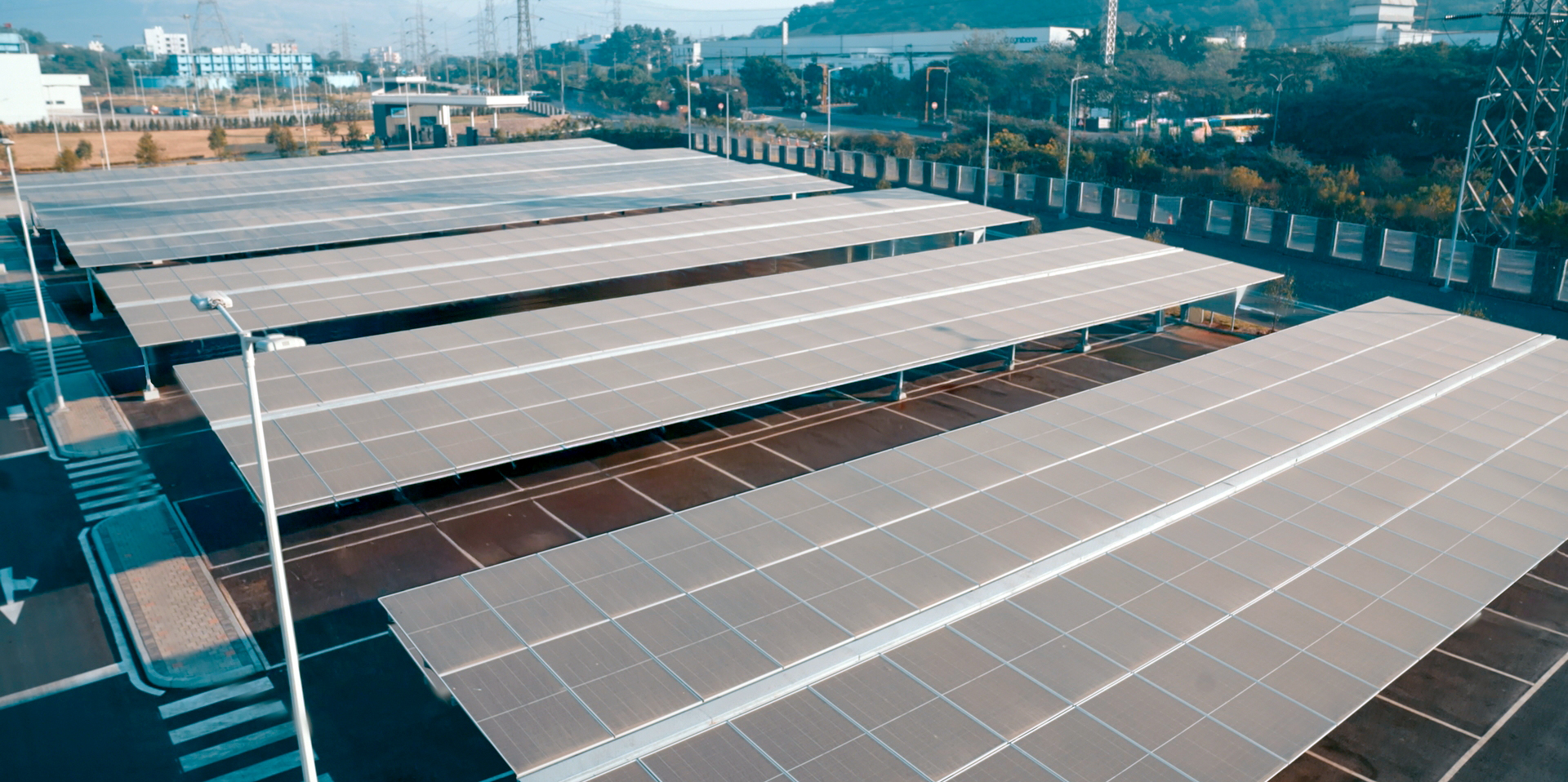
The Pune plant also pays close attention to how it manages electricity, water, and waste. In 2022, Hyundai Motor joined RE100, a global initiative committed to sourcing 100% of electricity from renewable sources by 2050, and has set its own goal of reaching that target by 2045. It is applying a range of solutions at its plants, including on-site solar panels, renewable energy certificates, and power purchase agreements.
Since it began operating in 2025, Pune plant has generated part of its electricity on site through an 814.8 kW solar installation over its VIP and employee parking areas. Through the purchase of International Renewable Energy Certificates (I-RECs), it also covered 100% of its electricity use with renewable energy from the start of operations through March 2026.
Water and resource management is another focus. Hyundai Motor continues to work on improving water-use efficiency and expanding water recycling at its sites, including the Pune plant. Waste is managed under the 3R principles of Reduce, Reuse, and Recycle. At the Pune plant, for example, waste cutting fluid is treated on site and converted into reusable water.
Hyundai Motor’s Next Chapter Starts in India
Hyundai Motor plans to expand the Pune plant’s annual production capacity to 320,000 units by 2030. Once the expansion is complete, Hyundai’s total production capacity in India is expected to exceed 1.14 million units. Investment will grow as well. Ahead of the inauguration, Hyundai Motor Group announced a medium- to long-term plan to invest USD 15.5 billion in India over the seven years from 2026 through 2032. The investment spans the automotive ecosystem as a whole, not just production capacity, and includes research and development (R&D), the parts supply chain, and new businesses.
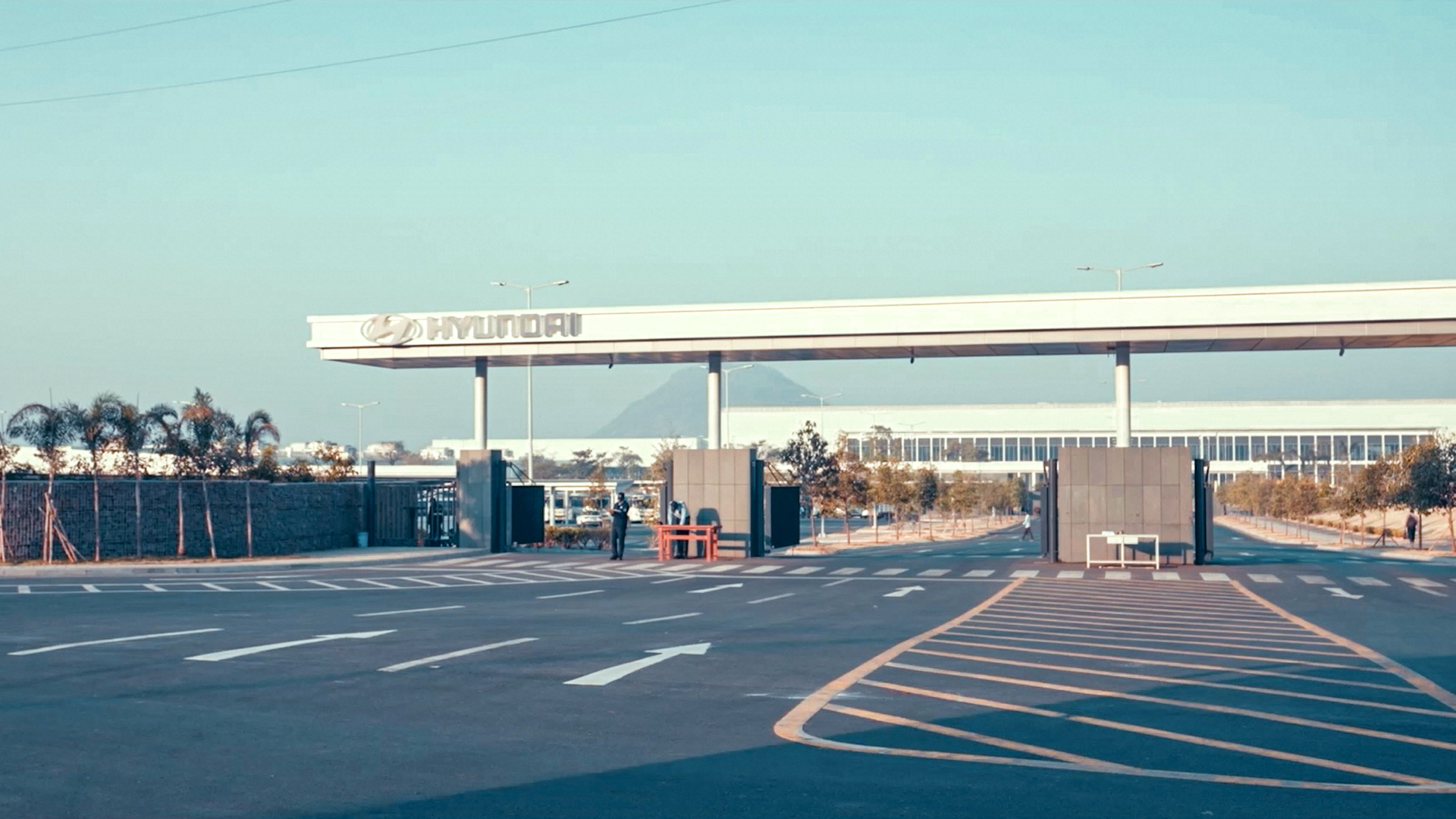
Alongside investment, the company is setting new records in exports. Hyundai Motor India became the first automaker in the country to surpass 4 million cumulative passenger car exports since 1999. The Pune plant is expected to play an even larger role in reaching the goal of exporting up to 30% of India-built vehicles by 2030, given its proximity to major ports.
As the Pune plant grows into a smart manufacturing base preparing for the future of India’s auto market, Hyundai Motor is building on its three decades of accumulated experience in India and planning the next 30 years. We look forward to the new chapter that the Pune plant will help write.
Photos: Hansoo Lim